Unified pluggable interface for AI/LLM service integration. More...
#include <stdbool.h>#include <stddef.h>#include <stdint.h>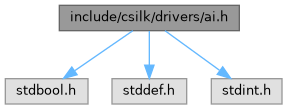

Go to the source code of this file.
Data Structures | |
| struct | csilk_ai_stats_t |
| AI Engine statistics. More... | |
| struct | csilk_ai_tool_function_t |
| A function tool definition for the AI model. More... | |
| struct | csilk_ai_tool_t |
| A tool that can be called by the model. More... | |
| struct | csilk_ai_tool_call_t |
| a tool call requested by the model. More... | |
| struct | csilk_ai_chat_request_t |
| Request parameters for chat completion. More... | |
| struct | csilk_ai_chat_response_t |
| Response data from a chat completion. More... | |
| struct | csilk_ai_embeddings_response_t |
| Response data for embeddings. More... | |
| struct | csilk_ai_driver_t |
| Virtual function table implemented by each AI provider backend. More... | |
| struct | csilk_ai_context_t |
| Helper to manage conversation context and history. More... | |
Typedefs | |
| typedef void(* | csilk_ai_stream_cb) (const char *chunk, void *user_data) |
| Callback for streaming mode. | |
| typedef void(* | csilk_ai_chat_async_cb) (int status, csilk_ai_chat_response_t *res, void *user_data) |
| Callback for asynchronous chat completion. | |
| typedef void(* | csilk_ai_embeddings_async_cb) (int status, csilk_ai_embeddings_response_t *res, void *user_data) |
| Callback for asynchronous embeddings. | |
Functions | |
| void | csilk_ai_get_stats (csilk_ai_stats_t *stats) |
| Get current AI engine statistics. | |
| char * | csilk_ai_stats_to_json (const csilk_ai_stats_t *stats) |
| Convert AI statistics to a JSON string. | |
| void | csilk_ai_register_monitor (void *c) |
| Register a WebSocket monitor for real-time AI events. | |
| csilk_ai_t * | csilk_ai_new (const char *driver_name, const char *api_key, const char *base_url) |
| Create a new AI instance with a specific driver. | |
| int | csilk_ai_chat (csilk_ai_t *ai, const csilk_ai_chat_request_t *req, csilk_ai_chat_response_t *res) |
| Perform a chat completion. | |
| void | csilk_ai_chat_async (csilk_ai_t *ai, const csilk_ai_chat_request_t *req, csilk_ai_chat_async_cb cb, void *user_data) |
| Perform an asynchronous chat completion. | |
| int | csilk_ai_embeddings (csilk_ai_t *ai, const char *model, const char **input, size_t count, csilk_ai_embeddings_response_t *res) |
| Generate embeddings for the given input strings. | |
| void | csilk_ai_embeddings_async (csilk_ai_t *ai, const char *model, const char **input, size_t count, csilk_ai_embeddings_async_cb cb, void *user_data) |
| Generate embeddings asynchronously. | |
| void | csilk_ai_free (csilk_ai_t *ai) |
| Free an AI handle. | |
| void | csilk_ai_chat_response_free (csilk_ai_chat_response_t *res) |
| Free a chat response structure. | |
| void | csilk_ai_embeddings_response_free (csilk_ai_embeddings_response_t *res) |
| Free an embeddings response structure. | |
| void | csilk_ai_register_driver (const csilk_ai_driver_t *driver) |
| Register a new AI driver. | |
| csilk_ai_context_t * | csilk_ai_context_new (size_t max_history) |
| Initialize a new conversation context. | |
| void | csilk_ai_context_add (csilk_ai_context_t *ctx, const char *role, const char *content) |
| Add a message to the context. | |
| void | csilk_ai_context_clear (csilk_ai_context_t *ctx) |
| Clear all messages from the context. | |
| void | csilk_ai_context_free (csilk_ai_context_t *ctx) |
| Free a conversation context. | |
Detailed Description
Unified pluggable interface for AI/LLM service integration.
Provides a provider-agnostic abstraction for chat completions, embeddings, streaming, and tool/function calling. Supports multiple backend drivers (OpenAI, Claude, Ollama, etc.) registered via csilk_ai_register_driver.
Architecture
The AI layer has three tiers:
- Driver — a csilk_ai_driver_t vtable implementing the actual HTTP/REST calls to a specific provider.
- Instance — created by csilk_ai_new(), wraps a driver + API config.
- Context — csilk_ai_context_t manages conversation history with a sliding-window FIFO (for maintaining chat context across turns).
Thread Safety
The driver functions are synchronous by default. Asynchronous variants (csilk_ai_chat_async) offload work to libuv's thread pool and invoke the callback on the main event loop, making them safe for use from request handlers.
- Copyright
- MIT License
Data Structure Documentation
◆ csilk_ai_stats_t
| struct csilk_ai_stats_t |
AI Engine statistics.
◆ csilk_ai_message_t
| struct csilk_ai_message_t |
◆ csilk_ai_tool_function_t
| struct csilk_ai_tool_function_t |
◆ csilk_ai_tool_t
| struct csilk_ai_tool_t |
A tool that can be called by the model.
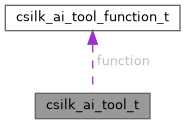
| Data Fields | ||
|---|---|---|
| csilk_ai_tool_function_t | function | |
| const char * | type |
Currently only "function" is supported. |
◆ csilk_ai_tool_call_t
| struct csilk_ai_tool_call_t |
◆ csilk_ai_chat_request_t
| struct csilk_ai_chat_request_t |
Request parameters for chat completion.
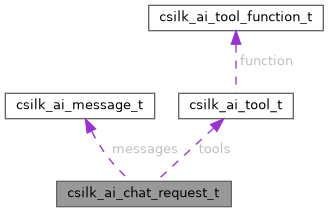
| Data Fields | ||
|---|---|---|
| double | frequency_penalty |
Penalty for repetitive tokens (-2.0 to 2.0). |
| int | max_tokens |
Maximum tokens to generate. |
| size_t | message_count |
Number of messages in the array. |
| csilk_ai_message_t * | messages |
Array of conversation messages. |
| const char * | model |
Provider-specific model name (e.g., "gpt-4"). |
| csilk_ai_stream_cb | on_chunk |
Callback invoked for each chunk in stream mode. |
| double | presence_penalty |
Penalty for new topics (-2.0 to 2.0). |
| const char ** | stop |
Array of stop sequences. |
| size_t | stop_count |
Number of stop sequences. |
| bool | stream |
Enable streaming mode. |
| double | temperature |
Sampling temperature (0.0 to 2.0). |
| int | timeout_ms |
Request timeout in milliseconds (0 for default). |
| const char * | tool_choice |
"none", "auto", or "required". |
| size_t | tool_count |
Number of tools. |
| csilk_ai_tool_t * | tools |
Available tools for the model. |
| double | top_p |
Nucleus sampling probability. |
| const char * | user |
Unique identifier for the end-user. |
| void * | user_data |
User context for the stream callback. |
◆ csilk_ai_chat_response_t
| struct csilk_ai_chat_response_t |
Response data from a chat completion.
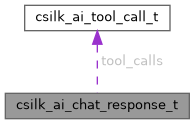
| Data Fields | ||
|---|---|---|
| int | completion_tokens |
Tokens used in the generation. |
| char * | content |
Generated text content (heap-allocated). |
| char * | error_message |
Detailed error message if call failed (heap-allocated). |
| int | prompt_tokens |
Tokens used in the prompt. |
| char * | raw_response |
Full raw JSON response (optional, heap-allocated). |
| size_t | tool_call_count |
Number of tool calls. |
| csilk_ai_tool_call_t * | tool_calls |
Array of tool calls (heap-allocated). |
| int | total_tokens |
Total tokens used. |
◆ csilk_ai_embeddings_response_t
| struct csilk_ai_embeddings_response_t |
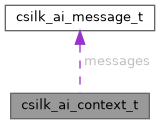
◆ csilk_ai_context_t
| struct csilk_ai_context_t |
Helper to manage conversation context and history.
| Data Fields | ||
|---|---|---|
| size_t | capacity |
Allocated capacity. |
| size_t | count |
Number of messages. |
| size_t | max_history |
Maximum messages to keep (0 for unlimited). |
| csilk_ai_message_t * | messages |
Array of history messages. |
Typedef Documentation
◆ csilk_ai_chat_async_cb
| typedef void(* csilk_ai_chat_async_cb) (int status, csilk_ai_chat_response_t *res, void *user_data) |
Callback for asynchronous chat completion.
◆ csilk_ai_embeddings_async_cb
| typedef void(* csilk_ai_embeddings_async_cb) (int status, csilk_ai_embeddings_response_t *res, void *user_data) |
Callback for asynchronous embeddings.
◆ csilk_ai_stream_cb
| typedef void(* csilk_ai_stream_cb) (const char *chunk, void *user_data) |
Callback for streaming mode.
- Parameters
-
chunk The text content delta. user_data User-provided context.
Function Documentation
◆ csilk_ai_chat()
| int csilk_ai_chat | ( | csilk_ai_t * | ai, |
| const csilk_ai_chat_request_t * | req, | ||
| csilk_ai_chat_response_t * | res | ||
| ) |
Perform a chat completion.
- Parameters
-
ai AI handle. req Chat request parameters. res [out] Chat response to populate.
- Returns
- 0 on success, -1 on failure.
Perform a chat completion.
Algorithm:
- Zero out the response struct for each attempt.
- Call the driver's chat() implementation.
- On success (status == 0), return immediately.
- On failure, check the error message for known transient error patterns (CURL transport errors, HTTP 429 rate limit, 502/503 server errors).
- If retryable and attempts remain, sleep with exponential backoff (1s, 2s) and retry. Non-retryable errors break immediately.
- Parameters
-
ai AI engine handle (must not be NULL). req Chat request parameters (model, messages, temperature, tools). res [out] Receives the chat response, including content, tool calls, and token usage. Zeroed on each retry attempt.
- Returns
- 0 on success, -1 if all retries are exhausted or parameters invalid.
- Note
- Not thread-safe. The caller must serialize access to the same csilk_ai_t handle.
◆ csilk_ai_chat_async()
| void csilk_ai_chat_async | ( | csilk_ai_t * | ai, |
| const csilk_ai_chat_request_t * | req, | ||
| csilk_ai_chat_async_cb | cb, | ||
| void * | user_data | ||
| ) |
Perform an asynchronous chat completion.
- Note
- Uses the framework's internal thread pool. The callback is invoked on the main loop.
Perform an asynchronous chat completion.
Allocates a work request and an async context on the heap, queues the work via uv_queue_work(), and returns immediately. The callback fires on the main loop thread after the driver's chat() completes. The response is valid only during the callback invocation.
Ownership: The caller retains ownership of req. The response res is owned by the async context and is freed after the callback returns. If the caller needs the response beyond the callback, it must deep-copy it.
- Parameters
-
ai AI engine handle. req Chat request (must remain valid until the callback fires). cb Completion callback (required). user_data Opaque pointer passed through to the callback.
- Note
- Thread-safe to call from any thread (libuv queues the work). On allocation failure, this is a silent no-op.
◆ csilk_ai_chat_response_free()
| void csilk_ai_chat_response_free | ( | csilk_ai_chat_response_t * | res | ) |
Free a chat response structure.
Free a chat response structure.
- Parameters
-
res Response struct to clean (may be NULL). Safe to call on a zero-initialized struct.
◆ csilk_ai_context_add()
| void csilk_ai_context_add | ( | csilk_ai_context_t * | ctx, |
| const char * | role, | ||
| const char * | content | ||
| ) |
Add a message to the context.
- Note
- Strings are duplicated internally.
Add a message to the context.
Algorithm:
- If the internal message array is full, double its capacity.
- If max_history > 0 and count >= max_history, remove the oldest message (free its role and content strings, shift remaining messages left via memmove, decrement count).
- strdup the role and content, append to the message array.
- Parameters
-
ctx Conversation context. role Message role (e.g., "user", "assistant", "system"). content Message content text.
- Note
- The role and content strings are deep-copied internally.
◆ csilk_ai_context_clear()
| void csilk_ai_context_clear | ( | csilk_ai_context_t * | ctx | ) |
Clear all messages from the context.
Clear all messages from the context.
- Parameters
-
ctx Conversation context (may be NULL).
◆ csilk_ai_context_free()
| void csilk_ai_context_free | ( | csilk_ai_context_t * | ctx | ) |
Free a conversation context.
Free a conversation context.
- Parameters
-
ctx Context to free (may be NULL).
◆ csilk_ai_context_new()
| csilk_ai_context_t * csilk_ai_context_new | ( | size_t | max_history | ) |
Initialize a new conversation context.
- Parameters
-
max_history Maximum number of messages to keep (FIFO sliding window).
Initialize a new conversation context.
Allocates a context struct that manages a rolling window of message history. When max_history messages are reached, the oldest message is evicted on each new add().
- Parameters
-
max_history Maximum number of messages to retain (0 = unlimited).
- Returns
- A new context handle, or NULL on allocation failure.
- Note
- The caller must free the handle with csilk_ai_context_free().
◆ csilk_ai_embeddings()
| int csilk_ai_embeddings | ( | csilk_ai_t * | ai, |
| const char * | model, | ||
| const char ** | input, | ||
| size_t | count, | ||
| csilk_ai_embeddings_response_t * | res | ||
| ) |
Generate embeddings for the given input strings.
- Parameters
-
ai AI handle. model Model name (e.g., "text-embedding-3-small"). input Array of strings to embed. count Number of strings. res [out] Embeddings response to populate.
- Returns
- 0 on success, -1 on failure.
Generate embeddings for the given input strings.
Checks that the driver supports embeddings (optional operation), then delegates to the driver's embeddings() implementation.
- Parameters
-
ai AI engine handle. model Model name (e.g., "text-embedding-3-small"). input Array of input strings to embed. count Number of input strings. res [out] Receives the embeddings values and error message.
- Returns
- 0 on success, -1 if the driver lacks embeddings support or parameters are invalid.
- Note
- Not thread-safe on the same csilk_ai_t handle.
◆ csilk_ai_embeddings_async()
| void csilk_ai_embeddings_async | ( | csilk_ai_t * | ai, |
| const char * | model, | ||
| const char ** | input, | ||
| size_t | count, | ||
| csilk_ai_embeddings_async_cb | cb, | ||
| void * | user_data | ||
| ) |
Generate embeddings asynchronously.
Generate embeddings asynchronously.
Allocates a work request and async context on the heap, queues via uv_queue_work(), and returns immediately. The callback fires on the main loop thread after completion.
- Parameters
-
ai AI engine handle. model Model name. input Array of input strings (must remain valid until callback). count Number of input strings. cb Completion callback (required). user_data Opaque pointer passed through to callback.
- Note
- The response is valid only during the callback invocation. Thread-safe to call from any thread.
◆ csilk_ai_embeddings_response_free()
| void csilk_ai_embeddings_response_free | ( | csilk_ai_embeddings_response_t * | res | ) |
Free an embeddings response structure.
Free an embeddings response structure.
- Parameters
-
res Response struct to clean (may be NULL).
◆ csilk_ai_free()
| void csilk_ai_free | ( | csilk_ai_t * | ai | ) |
Free an AI handle.
Free an AI handle.
- Parameters
-
ai The handle to free (may be NULL).
◆ csilk_ai_get_stats()
| void csilk_ai_get_stats | ( | csilk_ai_stats_t * | stats | ) |
Get current AI engine statistics.
- Parameters
-
stats [out] Pointer to stats struct to populate.
◆ csilk_ai_new()
| csilk_ai_t * csilk_ai_new | ( | const char * | driver_name, |
| const char * | api_key, | ||
| const char * | base_url | ||
| ) |
Create a new AI instance with a specific driver.
- Parameters
-
driver_name "openai", "ollama", or other registered driver names. api_key API key for the provider (may be NULL for Ollama). base_url Optional custom base URL (pass NULL for provider default).
- Returns
- New AI handle, or NULL if driver not found or init failed.
Create a new AI instance with a specific driver.
On the very first call, lazy-initializes the built-in driver registry (OpenAI and Ollama). Subsequent calls reuse the already-registered drivers. If the named driver is not found or its init() fails, returns NULL.
- Parameters
-
driver_name Backend name (e.g., "openai", "ollama"). api_key API key for authentication (e.g., OpenAI API key). base_url Optional custom base URL (NULL for driver default).
- Returns
- Newly allocated csilk_ai_t, or NULL on failure.
- Note
- The caller owns the returned handle and must free with csilk_ai_free(). On allocation failure, the driver state is freed internally to avoid leaks.
◆ csilk_ai_register_driver()
| void csilk_ai_register_driver | ( | const csilk_ai_driver_t * | driver | ) |
Register a new AI driver.
- Note
- Not thread-safe during registration. Call at startup.
Register a new AI driver.
- Parameters
-
driver Driver vtable with name, init, chat, embeddings, free.
◆ csilk_ai_register_monitor()
| void csilk_ai_register_monitor | ( | void * | c | ) |
Register a WebSocket monitor for real-time AI events.
- Parameters
-
c Framework context (WebSocket connection).
◆ csilk_ai_stats_to_json()
| char * csilk_ai_stats_to_json | ( | const csilk_ai_stats_t * | stats | ) |
Convert AI statistics to a JSON string.
- Parameters
-
stats Pointer to stats struct.
- Returns
- Heap-allocated JSON string (must be freed).
