Route group implementation — prefix nesting with inherited middleware. More...
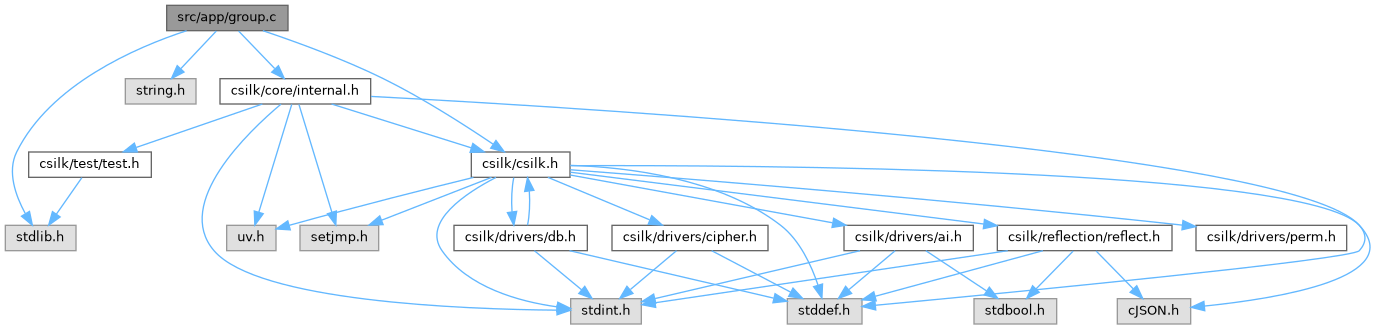
Data Structures | |
| struct | csilk_group_t |
| Route group structure. More... | |
Macros | |
| #define | CSILK_GROUP_MW_INIT_CAP 4 |
| Route group — holds a URL prefix, middleware chain, and optional parent group for nesting. | |
Functions | |
| static char * | join_path (const char *p1, const char *p2) |
| Internal: join two URL path components with a single '/' separator. | |
| csilk_group_t * | csilk_group_new (csilk_router_t *router, const char *prefix) |
| Create a new root route group with the given URL prefix. | |
| csilk_group_t * | csilk_group_group (csilk_group_t *parent, const char *prefix) |
| Create a child subgroup nested under a parent group. | |
| void | csilk_group_use (csilk_group_t *group, csilk_handler_t handler) |
| Register a middleware handler that applies to all routes in this group. | |
| static int | gather_handlers (csilk_group_t *group, csilk_handler_t **handlers, size_t *count) |
| Internal: recursively collect all middleware handlers from a group and its ancestors into a flat array. | |
| void | csilk_group_add_route (csilk_group_t *group, const char *method, const char *path, csilk_handler_t handler) |
| Register a route on this group with a single handler. | |
| void | csilk_group_add_route_extended (csilk_group_t *group, const char *method, const char *path, csilk_handler_t handler, const char *input_type, const char *output_type, const char *summary, const char *description) |
| Register a route with OpenAPI metadata (input/output types, summary, description). | |
| void | csilk_group_add_route_extended_perm (csilk_group_t *group, const char *method, const char *path, csilk_handler_t handler, const char *input_type, const char *output_type, const char *summary, const char *description, const char *perm_required, const char *perm_resource) |
| Add a route with OpenAPI/reflection metadata to a group. | |
| void | csilk_group_add_handlers (csilk_group_t *group, const char *method, const char *path, csilk_handler_t *handlers, size_t count) |
| Register a route with a custom chain of handlers (middleware + route handler). | |
| void | csilk_group_free (csilk_group_t *group) |
| Free all resources associated with a route group. | |
Detailed Description
Route group implementation — prefix nesting with inherited middleware.
Architecture
Route groups let users attach middleware + route handlers under a common URL prefix. Groups form a tree: a root group (prefix "") has zero or more child subgroups, each with their own prefix segment.
Middleware Chain Assembly
When a route is registered on a group, the framework:
- Recursively collects middleware from the group and all its ancestors (see gather_handlers()). Parent middleware comes first.
- Appends the route-specific handler chain.
- Registers the combined chain with the router.
This means parent-group middleware runs before child-group middleware for every request matching that prefix.
Prefix Joining
Path components are joined via join_path(), which normalizes slashes: e.g., parent="/api", child="/v1" → "/api/v1".
- Copyright
- MIT License
Data Structure Documentation
◆ csilk_group_s
| struct csilk_group_s |
Route group structure.
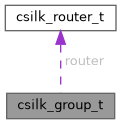
| Data Fields | ||
|---|---|---|
| size_t | middleware_capacity |
Allocated capacity (always ≥ count). |
| size_t | middleware_count |
Current number of middleware handlers. |
| csilk_handler_t * | middlewares |
Dynamically-grown array of middleware handlers for this group. Grown by doubling (initial cap = 4). Freed in csilk_group_free(). |
| csilk_group_t * | parent |
Parent group in the nesting tree, or NULL for root groups. Used by gather_handlers() to walk up the tree. Not owned. |
| char * | prefix |
URL prefix for routes in this group. Combined with parent prefix at creation via join_path(). Freed in csilk_group_free(). e.g., parent="/api", child="/v1" → "/api/v1". |
| csilk_router_t * | router |
Router where routes are registered. Inherited from parent or set explicitly in csilk_group_new(). Not owned by the group. |
Macro Definition Documentation
◆ CSILK_GROUP_MW_INIT_CAP
| #define CSILK_GROUP_MW_INIT_CAP 4 |
Route group — holds a URL prefix, middleware chain, and optional parent group for nesting.
Groups form a tree via the parent pointer. The full middleware chain for any route is the concatenation of parent middleware (recursively) followed by this group's middleware, followed by the route handlers.
Function Documentation
◆ csilk_group_add_handlers()
| void csilk_group_add_handlers | ( | csilk_group_t * | group, |
| const char * | method, | ||
| const char * | path, | ||
| csilk_handler_t * | handlers, | ||
| size_t | count | ||
| ) |
Register a route with a custom chain of handlers (middleware + route handler).
Add a route with an explicit array of handlers.
Assembly pipeline
- join_path(group->prefix, path) → full_path (e.g., "/api/v1/users").
- gather_handlers(group, ...) → flat array of all inherited middleware (parent first, then child), grown via realloc.
- realloc to append caller's handlers[] to the end.
- csilk_router_add(group->router, method, full_path, combined, count).
The final handler chain stored in the router looks like: [parent_mw..., group_mw..., handler_1, ..., handler_n]
- Parameters
-
group The route group. method HTTP method. path Path relative to the group prefix. handlers Array of handler functions (the chain). count Number of handlers in the array.
- Note
- The handlers array is combined with group middleware — group middleware always runs first, followed by the provided handlers.
◆ csilk_group_add_route()
| void csilk_group_add_route | ( | csilk_group_t * | group, |
| const char * | method, | ||
| const char * | path, | ||
| csilk_handler_t | handler | ||
| ) |
Register a route on this group with a single handler.
Add a route to the group.
The route's path is automatically prefixed with the group's prefix. The handler is wrapped in a 1-element array and passed to csilk_group_add_handlers() which combines group middleware.
- Parameters
-
group The route group. method HTTP method (e.g., "GET", "POST"). path Path relative to the group prefix (e.g., "/users"). handler The route handler function.
◆ csilk_group_add_route_extended()
| void csilk_group_add_route_extended | ( | csilk_group_t * | group, |
| const char * | method, | ||
| const char * | path, | ||
| csilk_handler_t | handler, | ||
| const char * | input_type, | ||
| const char * | output_type, | ||
| const char * | summary, | ||
| const char * | description | ||
| ) |
Register a route with OpenAPI metadata (input/output types, summary, description).
Add a route with OpenAPI/reflection metadata to a group.
Like csilk_group_add_route() but enriches the route with metadata used by the OpenAPI spec generator. The metadata is stored in the method handler for later retrieval by csilk_generate_openapi_json().
- Parameters
-
group The route group. method HTTP method. path Path relative to the group prefix. handler The route handler function. input_type Registered reflection type name for the request body (e.g., "CreateUserRequest"), or NULL. output_type Registered reflection type name for the response body, or NULL. summary Short description for OpenAPI operation summary. description Detailed description for OpenAPI operation.
◆ csilk_group_add_route_extended_perm()
| void csilk_group_add_route_extended_perm | ( | csilk_group_t * | group, |
| const char * | method, | ||
| const char * | path, | ||
| csilk_handler_t | handler, | ||
| const char * | input_type, | ||
| const char * | output_type, | ||
| const char * | summary, | ||
| const char * | description, | ||
| const char * | perm_required, | ||
| const char * | perm_resource | ||
| ) |
Add a route with OpenAPI/reflection metadata to a group.
Add a route with full OpenAPI metadata and permission requirements to a group.
Extended version that also records input/output types and documentation for automatic OpenAPI spec generation.
- Parameters
-
group The route group. method HTTP method. path Path relative to the group prefix. handler The route handler function. input_type Registered type name for request-body binding (NULL if none). output_type Registered type name for response serialisation (NULL if none). summary Short operation summary for OpenAPI (NULL to omit). description Detailed operation description for OpenAPI (NULL to omit).
Add a route with OpenAPI/reflection metadata to a group.
Like csilk_group_add_route() but enriches the route with metadata used by the OpenAPI spec generator. The metadata is stored in the method handler for later retrieval by csilk_generate_openapi_json().
- Parameters
-
group The route group. method HTTP method. path Path relative to the group prefix. handler The route handler function. input_type Registered reflection type name for the request body (e.g., "CreateUserRequest"), or NULL. output_type Registered reflection type name for the response body, or NULL. summary Short description for OpenAPI operation summary. description Detailed description for OpenAPI operation. perm_required Permission required for this route, or NULL. perm_resource Resource pattern for permission check, or NULL.
Permission metadata is forwarded to the router which stores it alongside the route for authorization middleware to inspect at request time.
◆ csilk_group_free()
| void csilk_group_free | ( | csilk_group_t * | group | ) |
Free all resources associated with a route group.
Destroy a route group and release its resources.
Releases the group's prefix string, middleware handlers array, and the group struct itself. Does NOT free child groups or the router.
- Parameters
-
group The group to free (may be NULL).
- Note
- Child groups created with csilk_group_group() must be freed separately. The router is not owned by the group.
◆ csilk_group_group()
| csilk_group_t * csilk_group_group | ( | csilk_group_t * | parent, |
| const char * | prefix | ||
| ) |
Create a child subgroup nested under a parent group.
Create a nested sub-group within an existing group.
The child inherits the parent's router and its prefix is joined with the parent's prefix (e.g., parent="/api", child="/v1" -> combined prefix "/api/v1").
- Parameters
-
parent The parent group (cannot be NULL). prefix URL prefix for this subgroup (e.g., "/v1").
- Returns
- A new csilk_group_t, or NULL on failure.
- Note
- The child must be freed separately with csilk_group_free() — freeing the parent does NOT free its children.
◆ csilk_group_new()
| csilk_group_t * csilk_group_new | ( | csilk_router_t * | router, |
| const char * | prefix | ||
| ) |
Create a new root route group with the given URL prefix.
Create a new route group with a URL prefix.
Root groups are attached directly to a router. All routes added to this group will be prefixed with prefix.
- Parameters
-
router The router instance this group belongs to. prefix URL prefix for all routes in this group (e.g., "/api/v1"). Pass NULL or "/" for no prefix.
- Returns
- A new csilk_group_t, or NULL on allocation failure.
- Note
- The group must be freed with csilk_group_free().
◆ csilk_group_use()
| void csilk_group_use | ( | csilk_group_t * | group, |
| csilk_handler_t | handler | ||
| ) |
Register a middleware handler that applies to all routes in this group.
Add middleware to a group.
Middleware handlers are executed before route handlers in the order they are registered. The internal middleware array grows dynamically (doubling capacity) as needed.
- Parameters
-
group The route group. handler Middleware handler function. Receives the request context and should call csilk_next() to pass control forward.
- Note
- Middleware from parent groups is automatically inherited by child groups and prepended before child middleware.
◆ gather_handlers()
|
static |
Internal: recursively collect all middleware handlers from a group and its ancestors into a flat array.
How middleware inheritance works
The recursion goes depth-first to the root, then appends middleware on the way back up:
gather_handlers(child, &arr, &n) → gather_handlers(parent, &arr, &n) // recurse to root first → gather_handlers(grandparent, &arr, &n) // root's parent is NULL → (no parent — return) → memcpy grandparent's middlewares into arr[n..] → n += grandparent.middleware_count → memcpy parent's middlewares into arr[n..] → n += parent.middleware_count → memcpy child's middlewares into arr[n..] → n += child.middleware_count
Result: [grandparent_mw..., parent_mw..., child_mw...] This guarantees parent middleware executes before child middleware.
- Parameters
-
group The leaf group. handlers [in/out] Pointer to the handlers array (realloc'd as needed). count [in/out] Number of handlers collected so far.
- Returns
- 0 on success, -1 on realloc failure.
- Note
- The caller must free the returned handlers array with free().
◆ join_path()
|
static |
Internal: join two URL path components with a single '/' separator.
Algorithm
- Handle trivial cases: if either component is NULL or empty, return a strdup of the other (or "/" if both are empty).
- Strip trailing slashes from p1 by decrementing l1.
- Strip leading slashes from p2 by advancing p2_start.
- Allocate l1 + l2 + 1 (slash) + 1 (null) bytes.
- Memcpy p1, then '/', then p2_start.
Examples: join_path("/api/", "/v1") → "/api/v1" join_path("api", "v1") → "api/v1" join_path(NULL, "/users") → "/users" join_path("", "") → "/"
- Parameters
-
p1 First path component (may be empty or NULL). p2 Second path component (may be empty or NULL).
- Returns
- A newly heap-allocated joined path string. Caller must free().
- Note
- Returns strdup("/") if both components are NULL or empty.
