Router implementation using a radix tree (trie) for URL path matching. More...
#include <stdlib.h>#include <string.h>#include "context_internal.h"#include "csilk/core/internal.h"#include "csilk/csilk.h"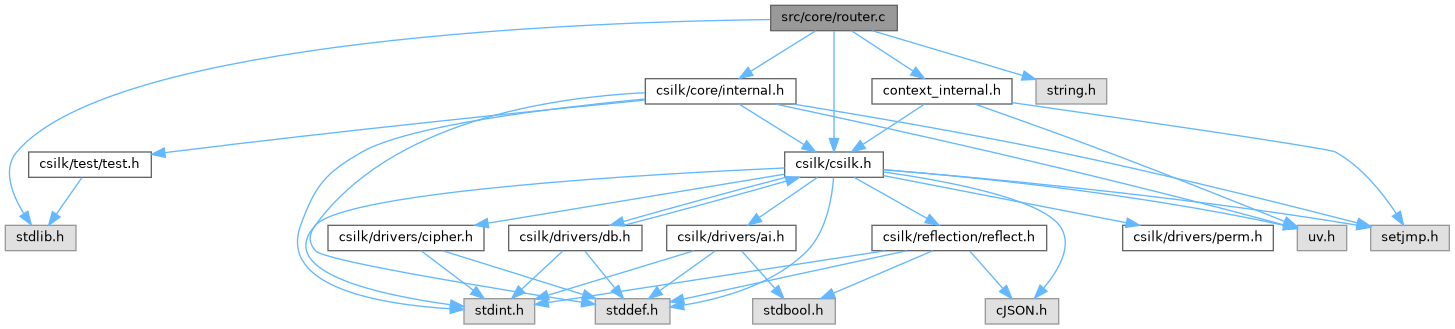
Data Structures | |
| struct | csilk_router_node_t |
| Node in the router trie — represents a URL path segment. More... | |
Macros | |
| #define | CSILK_MAX_CHILDREN 128 |
| Maximum number of children per router tree node. | |
Enumerations | |
| enum | csilk_node_type_t { CSILK_NODE_STATIC , CSILK_NODE_PARAM , CSILK_NODE_WILDCARD } |
| Node type for router trie. More... | |
Functions | |
| static csilk_router_node_t * | node_new (const char *segment, csilk_node_type_t type) |
| Create a new router trie node. | |
| static void | node_free (csilk_router_node_t *node) |
| Recursively free a router trie node and all its descendants. | |
| static const char * | get_next_segment (const char **p, size_t *len) |
| Extract the next path segment from a URL path string. | |
| csilk_router_t * | csilk_router_new () |
| Create a new router instance with an empty root ("") static node. | |
| void | csilk_router_free (csilk_router_t *r) |
| Free a router instance and all its trie nodes. | |
| static void | node_collect_routes (csilk_router_node_t *node, cJSON *routes) |
| Internal: recursively traverse the trie and collect all route metadata. | |
| cJSON * | csilk_router_collect_routes (csilk_router_t *r) |
| Collect all registered routes from the router tree as a cJSON array. | |
| static void | router_add_full (csilk_router_t *r, const char *method, const char *path, csilk_handler_t *handlers, size_t handler_count, const char *path_pattern, const char *input_type, const char *output_type, const char *summary, const char *description, const char *perm_required, const char *perm_resource) |
| Register a route with method, path pattern, handler chain, and optional OpenAPI metadata. | |
| void | csilk_router_add_extended (csilk_router_t *r, const char *method, const char *path, csilk_handler_t *handlers, size_t handler_count, const char *path_pattern, const char *input_type, const char *output_type, const char *summary, const char *description) |
| Register a route with full OpenAPI/reflection metadata. | |
| void | csilk_router_add (csilk_router_t *r, const char *method, const char *path, csilk_handler_t *handlers, size_t handler_count) |
| Register a route with method, path pattern, and handler chain (no OpenAPI metadata). | |
| void | csilk_router_add_perm (csilk_router_t *r, const char *method, const char *path, csilk_handler_t *handlers, size_t handler_count, const char *perm_required, const char *perm_resource) |
| Register a route with permission metadata. | |
| void | csilk_router_add_extended_perm (csilk_router_t *r, const char *method, const char *path, csilk_handler_t *handlers, size_t handler_count, const char *path_pattern, const char *input_type, const char *output_type, const char *summary, const char *description, const char *perm_required, const char *perm_resource) |
| Register a route with full metadata including permissions. | |
| static csilk_handler_t * | match_node (csilk_router_node_t *node, const char *method, const char *path, csilk_ctx_t *ctx, csilk_method_handler_t **out_mh) |
| Recursively match a request path against the trie from the given node. | |
| csilk_handler_t * | csilk_router_match (csilk_router_t *r, const char *method, const char *path) |
| Match a method+path against the routing table (standalone, no context). | |
| int | csilk_router_match_ctx (csilk_router_t *r, csilk_ctx_t *c) |
| Match the current request context against the routing table and populate path params. | |
Detailed Description
Router implementation using a radix tree (trie) for URL path matching.
- Copyright
- MIT License
=== Architecture Overview ===
The router organises registered URL patterns into a compressed trie (radix tree). Each node represents a single path segment, and the path from root to a handler-holding node encodes the full route pattern.
Node types (csilk_node_type_t): STATIC - Matches a literal segment, e.g. "users", "api", "v1". Comparison is a simple strcmp against the request segment. PARAM - Matches any single segment; the matched value is captured as a named parameter. Identified by a ':' prefix in the registered pattern (e.g., "/:id" -> segment="id"). WILDCARD - Matches the remainder of the path (one or more segments). Identified by a '*' prefix (e.g., "WILDCARD filepath"). Once a wildcard node is reached, matching stops and the entire tail of the URL is captured as a single parameter.
Insertion (router_add_full): The path is split into segments by '/'. For each segment, the algorithm checks whether a child node of the same type and segment name already exists. If not, a new node is created and appended. The method handler chain is stored at the final (leaf) node.
Matching (match_node): Recursive depth-first search with backtracking. At each node, the next segment from the request path is extracted via get_next_segment(). The algorithm tries all children in order: STATIC children are compared exactly; PARAM children always match (capturing the segment value); WILDCARD children match the remaining path and terminate the search. When a PARAM branch fails deeper in the tree, the capture is rolled back (params_count decremented, memory freed) so sibling STATIC or PARAM nodes can be tried. The first successful match is returned.
Priority / ordering: Children are tried in insertion order. STATIC and PARAM nodes at the same depth are both explored, but STATIC is attempted first if inserted before a corresponding PARAM. For well-defined priority, register STATIC routes before PARAM routes at the same level. WILDCARD nodes terminate the path and are tried as a fallback.
Data Structure Documentation
◆ csilk_router_node_s
| struct csilk_router_node_s |
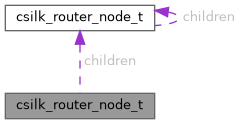
Node in the router trie — represents a URL path segment.
Opaque router node type.
The router uses a radix tree (trie) structure where each node represents a path segment. Nodes can be static (e.g., "users"), parameterized (e.g., ":id"), or wildcard (e.g., "*"). Each node stores handlers for matching HTTP methods at that path.
Nodes form a compressed radix tree (Patricia trie) for efficient path matching. Each node may hold handlers for one or more HTTP methods.
| Data Fields | ||
|---|---|---|
| struct csilk_router_node_s * | children[CSILK_MAX_CHILDREN] |
Child nodes array. |
| int | children_count |
Number of child nodes. |
| csilk_method_handler_t * | handlers |
Method handlers for this node. |
| char * | segment |
URL path segment. |
| csilk_node_type_t | type |
Type of node (static/param/wildcard). |
Macro Definition Documentation
◆ CSILK_MAX_CHILDREN
| #define CSILK_MAX_CHILDREN 128 |
Maximum number of children per router tree node.
Enumeration Type Documentation
◆ csilk_node_type_t
| enum csilk_node_type_t |
Node type for router trie.
CSILK_NODE_STATIC - Matches a literal path segment (e.g., "users"). strcmp equality is required for a match. CSILK_NODE_PARAM - Matches any single path segment. The segment name (without ':' prefix) becomes the parameter key. e.g., ":id" captures "42" as ctx->params["id"]. CSILK_NODE_WILDCARD - Matches the remainder of the URL path (any number of segments including none). The segment name (without '*' prefix) becomes the parameter key. e.g., "WILDCARD path" captures "foo/bar/baz" for request "/foo/bar/baz". Wildcard is terminal and always tried last during matching.
| Enumerator | |
|---|---|
| CSILK_NODE_STATIC | |
| CSILK_NODE_PARAM | |
| CSILK_NODE_WILDCARD | |
Function Documentation
◆ csilk_router_add()
| void csilk_router_add | ( | csilk_router_t * | r, |
| const char * | method, | ||
| const char * | path, | ||
| csilk_handler_t * | handlers, | ||
| size_t | handler_count | ||
| ) |
Register a route with method, path pattern, and handler chain (no OpenAPI metadata).
Register a route with one or more handlers.
Convenience wrapper around csilk_router_add_extended() that passes NULL for all optional metadata fields.
- Parameters
-
r The router instance. method HTTP method. path URL path pattern. handlers Array of handler functions. handler_count Number of handlers.
◆ csilk_router_add_extended()
| void csilk_router_add_extended | ( | csilk_router_t * | r, |
| const char * | method, | ||
| const char * | path, | ||
| csilk_handler_t * | handlers, | ||
| size_t | handler_count, | ||
| const char * | path_pattern, | ||
| const char * | input_type, | ||
| const char * | output_type, | ||
| const char * | summary, | ||
| const char * | description | ||
| ) |
Register a route with full OpenAPI/reflection metadata.
Extended version of csilk_router_add that also stores metadata for automatic OpenAPI spec generation and request/response binding.
- Parameters
-
r Router instance. method HTTP method string. path URL pattern (e.g., "/users/:id"). handlers Array of handler functions. handler_count Number of handlers in handlers.path_pattern Canonical path pattern string for documentation (may differ from the radix-tree path). input_type Registered type name for request-body binding (NULL if there is no request body). output_type Registered type name for response serialisation (NULL if raw response is used). summary Short summary of the operation (NULL to omit from spec). description Detailed description of the operation (NULL to omit).
◆ csilk_router_add_extended_perm()
| void csilk_router_add_extended_perm | ( | csilk_router_t * | r, |
| const char * | method, | ||
| const char * | path, | ||
| csilk_handler_t * | handlers, | ||
| size_t | handler_count, | ||
| const char * | path_pattern, | ||
| const char * | input_type, | ||
| const char * | output_type, | ||
| const char * | summary, | ||
| const char * | description, | ||
| const char * | perm_required, | ||
| const char * | perm_resource | ||
| ) |
Register a route with full metadata including permissions.
Combines csilk_router_add_extended with permission metadata in a single call. The permission fields are used by csilk_perm_auto_middleware.
- Parameters
-
r The router instance. method HTTP method. path URL path pattern. handlers Array of handler functions. handler_count Number of handlers. path_pattern Original path pattern for OpenAPI metadata. input_type Registered type name for request body, or NULL. output_type Registered type name for response body, or NULL. summary OpenAPI operation summary, or NULL. description OpenAPI operation description, or NULL. perm_required Permission identifier (e.g., "read"), or NULL. perm_resource Resource pattern (e.g., "users:*"), or NULL.
◆ csilk_router_add_perm()
| void csilk_router_add_perm | ( | csilk_router_t * | r, |
| const char * | method, | ||
| const char * | path, | ||
| csilk_handler_t * | handlers, | ||
| size_t | handler_count, | ||
| const char * | perm_required, | ||
| const char * | perm_resource | ||
| ) |
Register a route with permission metadata.
Same as csilk_router_add but also stores permission requirement for interface-level access control. The auto-check middleware (csilk_perm_auto_middleware) reads these fields at request time.
- Parameters
-
r The router instance. method HTTP method. path URL path pattern. handlers Array of handler functions. handler_count Number of handlers. perm_required Permission identifier (e.g., "read", "write"), or NULL. perm_resource Resource pattern (e.g., "users:*"), or NULL.
◆ csilk_router_collect_routes()
| cJSON * csilk_router_collect_routes | ( | csilk_router_t * | r | ) |
Collect all registered routes from the router tree as a cJSON array.
Traverses the entire trie and returns a JSON array where each element is an object with method, path, input_type, output_type, summary, and description fields.
- Parameters
-
r The router instance.
- Returns
- A cJSON array of route objects. Caller must free with cJSON_Delete(). Returns NULL if the router is NULL or allocation fails.
◆ csilk_router_free()
| void csilk_router_free | ( | csilk_router_t * | r | ) |
Free a router instance and all its trie nodes.
Destroy the router and release all its resources.
Recursively frees the entire trie starting from the root node, then frees the router struct itself.
- Parameters
-
r The router to free (may be NULL).
◆ csilk_router_match()
| csilk_handler_t * csilk_router_match | ( | csilk_router_t * | r, |
| const char * | method, | ||
| const char * | path | ||
| ) |
Match a method+path against the routing table (standalone, no context).
Match a raw method+path to handlers (standalone, no context).
Direct matching without populating path parameters. Useful for checking whether a route exists without processing a full request.
- Parameters
-
r The router instance. method HTTP method. path URL path.
- Returns
- Pointer to the handler array if matched, NULL otherwise.
- Note
- No parameter capture is performed since no context is provided.
◆ csilk_router_match_ctx()
| int csilk_router_match_ctx | ( | csilk_router_t * | r, |
| csilk_ctx_t * | c | ||
| ) |
Match the current request context against the routing table and populate path params.
Match the current request against the router and update the context.
Sets the context's handlers array, handler index (reset to -1), and current_handler metadata on a successful match. Path parameters are captured into the context's params array.
- Parameters
-
r The router instance. c The request context (must have method and path set).
- Returns
- 1 if a matching route was found, 0 otherwise.
- Note
- On success, the context is ready for csilk_next() to begin handler execution. On failure, the caller should send a 404 response.
◆ csilk_router_new()
| csilk_router_t * csilk_router_new | ( | void | ) |
Create a new router instance with an empty root ("") static node.
Create a new empty router.
- Returns
- A new csilk_router_t, or NULL on allocation failure.
- Note
- The router must be freed with csilk_router_free(). The root node is a static node with an empty segment, representing the root "/".
◆ get_next_segment()
|
static |
Extract the next path segment from a URL path string.
get_next_segment is the bridge between the raw URL path and the trie traversal. It consumes one segment at a time, providing the atomic unit that each trie node represents.
Behaviour:
- Skip all leading '/' characters — this normalises paths such as "//foo//bar" into the same segments as "/foo/bar".
- If the remaining string is empty after skipping slashes, return NULL (no more segments).
- Record the start pointer, then advance until the next '/' or end-of-string. The characters in between form one segment.
- Allocate and return a heap copy of that segment.
- Advance the caller's pointer (
p) past the consumed segment so that repeated calls walk sequentially through the path.
Example: for path "/users/42/profile" Call 1: returns "users", p -> "/42/profile" Call 2: returns "42", p -> "/profile" Call 3: returns "profile", p -> "" Call 4: returns NULL
Edge cases:
- Leading slashes are always skipped, so path "/" yields NULL (zero segments), matching the root node.
- Paths with trailing slashes like "/users/" return "users" then NULL — the trailing '/' is consumed but produces no segment.
- Parameters
-
p [in/out] Pointer to the current position in the path string. Updated to point past the extracted segment. len [out] Pointer to receive the length of the segment.
- Returns
- A pointer to the start of the segment within the original path string, or NULL if no more segments are found.
◆ match_node()
|
static |
Recursively match a request path against the trie from the given node.
This is the core matching function. It implements a depth-first, backtracking search over the radix tree:
- Base case: if the remaining path is empty, "/", or NULL, check whether the current node has a handler for the given HTTP method. If so, return it — this is a successful terminal match.
- Extract the next segment from the request path via get_next_segment().
- Try children in insertion order. For each child:
- STATIC: match if child->segment == extracted segment (strcmp).
- PARAM: always match; capture segment value into ctx->params.
- WILDCARD: always match; capture the entire remaining path into ctx->params. Since wildcard consumes everything, check its handlers directly (no further recursion).
- Recurse: if the child matches, call match_node() on it with the remaining path pointer (p). Propagate the result back up.
- Backtrack: if recursion returns NULL (no handler found deeper), undo any PARAM capture that was made for this branch (decrement params_count, free key/value strings). Continue to the next sibling child.
- If no child matches or all branches return NULL, free the segment and return NULL — no route matched.
=== Why backtracking matters === Consider routes: GET /users/:id (PARAM) GET /users/me (STATIC) Request: GET /users/me
The algorithm tries STATIC "me" first (if inserted first). If STATIC has a handler for GET, it is returned immediately. If STATIC had no handler, the search backtracks and tries PARAM ":id", which matches "me" as a parameter. This ensures STATIC routes take priority over PARAM routes when both could match.
- Parameters
-
node Current trie node to match against. method HTTP method to match. path Remaining path string (may be "" or "/" for exact match). ctx Request context for parameter capture (may be NULL for standalone matching). out_mh [out] Optional pointer to receive the matched method handler metadata (for OpenAPI metadata access).
- Returns
- Pointer to the NULL-terminated handler array, or NULL if no match.
- Note
- Parameter and wildcard values are strdup'd and must be freed by the caller (or during csilk_ctx_cleanup()).
◆ node_collect_routes()
|
static |
Internal: recursively traverse the trie and collect all route metadata.
For each node, iterates the method handler linked list and adds a route object (method, path, input_type, output_type, summary, description) to the cJSON array. Then recurses into child nodes.
- Parameters
-
node Current trie node. routes cJSON array to append route objects to.
◆ node_free()
|
static |
Recursively free a router trie node and all its descendants.
Frees the segment string, the linked list of method handlers (including method, handlers array, and path strings), recursively frees all child nodes, and finally frees the node itself.
- Parameters
-
node The node to free (may be NULL).
◆ node_new()
|
static |
Create a new router trie node.
Allocates and initializes a node with the given path segment and type. The segment string is duplicated internally.
- Parameters
-
segment The path segment name (e.g., "users", "id" for ":id"). type The node type (static, param, or wildcard).
- Returns
- A new csilk_router_node_t, or NULL on allocation failure.
- Note
- The returned node must be freed with node_free().
◆ router_add_full()
|
static |
Register a route with method, path pattern, handler chain, and optional OpenAPI metadata.
Walks the path string, segment by segment, inserting nodes into the trie. Path segments prefixed with ':' are treated as parameters (e.g., "/:id"), and segments prefixed with '*' are treated as wildcards that match the remainder of the path (e.g., "/assets/star-path"). The method handler is stored at the final node with the provided metadata. If a route with the same method already exists at the same path, the new registration is silently ignored (no override).
- Parameters
-
r The router instance. method HTTP method (e.g., "GET", "POST"). path URL path pattern (e.g., "/users/:id"). handlers Array of handler functions (NULL-terminated). handler_count Number of handlers (excluding the NULL terminator). path_pattern Original path pattern for OpenAPI metadata (may differ from pathif prefix was prepended by group).input_type Registered type name for request body, or NULL. output_type Registered type name for response body, or NULL. summary OpenAPI operation summary, or NULL. description OpenAPI operation description, or NULL.
- Note
- The router does NOT support overriding an existing route — duplicate method+path registrations are silently dropped.
- The handler array is copied; the caller may free it after this call.
