Core event-driven HTTP server implementation. More...
#include <limits.h>#include <llhttp.h>#include <openssl/err.h>#include <openssl/ssl.h>#include <stdatomic.h>#include <stdbool.h>#include <stdio.h>#include <stdlib.h>#include <string.h>#include <uv.h>#include "context_internal.h"#include "csilk/core/internal.h"#include "csilk/csilk.h"#include "server_internal.h"#include "h2.h"#include "csilk/reflection/reflect.h"#include <netinet/in.h>#include <sys/socket.h>#include <unistd.h>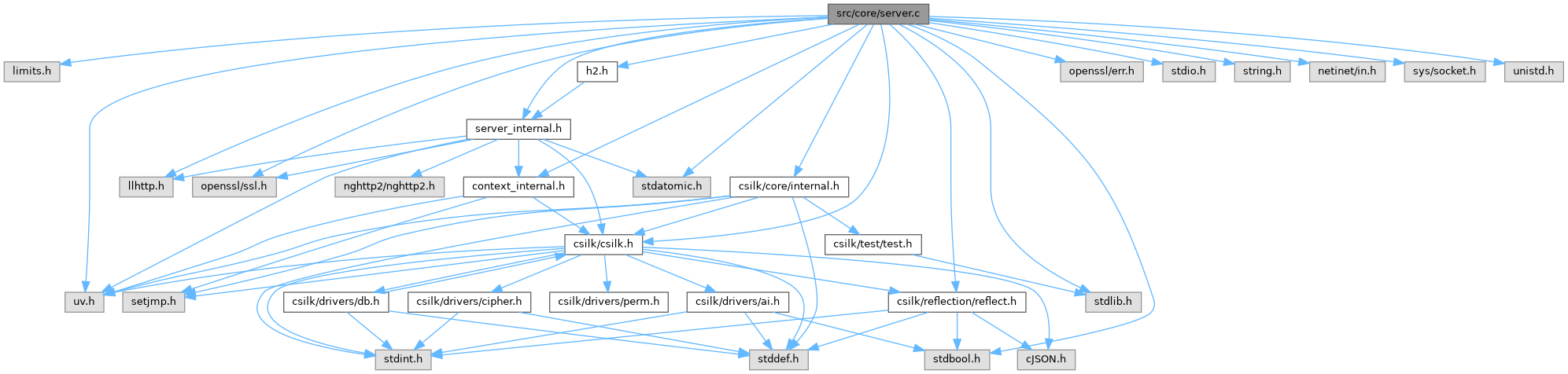
Data Structures | |
| struct | worker_data_t |
| Per-worker thread initialization data for SO_REUSEPORT multi-loop mode. More... | |
| struct | worker_stop_data_t |
Macros | |
| #define | UV_HANDLE_BOUND 0x00002000 |
Functions | |
| static void | alloc_buffer (uv_handle_t *handle, size_t suggested_size, uv_buf_t *buf) |
| libuv buffer allocation callback — allocates a receive buffer. | |
| static void | on_read (uv_stream_t *stream, ssize_t nread, const uv_buf_t *buf) |
| libuv read callback — processes incoming data from a client connection. | |
| static void | on_idle_timeout (uv_timer_t *handle) |
| libuv timer callback: fired when the connection has been idle (no active request) beyond keepalive_idle_ms. | |
| static void | on_write_timeout (uv_timer_t *handle) |
| libuv timer callback: fired when the response write has not completed within write_timeout_ms. | |
| static void | on_server_handle_close (uv_handle_t *handle) |
| libuv close callback for server-level handles during shutdown. | |
| static void | init_tls (csilk_server_t *s) |
| Initialize the server's TLS/SSL context using OpenSSL. | |
| static void | cleanup_tls (csilk_server_t *s) |
| Clean up the server's TLS/SSL context and global SSL state. | |
| static int | setup_client_tls (csilk_client_t *client) |
| Set up TLS for an individual client connection. | |
| static void | process_tls_read (csilk_client_t *client) |
| Process incoming TLS data — complete the handshake or decrypt application data. | |
| static void | flush_tls_write (csilk_client_t *client) |
| Flush buffered TLS encrypted data to the client socket. | |
| static void | trigger_hooks (csilk_server_t *s, csilk_ctx_t *c, csilk_hook_type_t type) |
| Internal: invoke all registered handlers for a given hook type. | |
| static csilk_client_t * | pool_get (csilk_server_t *server) |
| Get a client connection object from the server's free pool or allocate a new one. | |
| static void | pool_put (csilk_server_t *server, csilk_client_t *client) |
| Return a client connection to the server's free pool for reuse. | |
| static void | client_list_add (csilk_server_t *server, csilk_client_t *client) |
| Insert a client at the head of the server's active client list. | |
| static void | client_list_remove_internal (csilk_server_t *server, csilk_client_t *client) |
| Remove a client from the active list (no locking). | |
| static void | client_list_remove (csilk_server_t *server, csilk_client_t *client) |
| Remove a client from the active list (thread-safe). | |
| static void | on_timer_close (uv_handle_t *handle) |
| libuv close callback for client timer handles. | |
| static void | on_close (uv_handle_t *handle) |
| libuv close callback for client TCP handles — performs full cleanup. | |
| static void | on_signal (uv_signal_t *handle, int signum) |
| libuv signal handler for SIGINT — initiates graceful server shutdown. | |
| static void | on_stop_async (uv_async_t *handle) |
| libuv async callback to stop the server gracefully. | |
| static void | on_sendfile_complete (uv_fs_t *req) |
| libuv sendfile completion callback — continues with keep-alive or close. | |
| static void | on_write (uv_write_t *req, int status) |
| libuv write completion callback — handles post-write pipeline. | |
| static void | on_read_timeout (uv_timer_t *handle) |
| libuv timer callback: fired when no request data has been received within read_timeout_ms. | |
| static int | on_message_begin (llhttp_t *p) |
| llhttp callback: a new HTTP message begins. | |
| static int | on_url (llhttp_t *p, const char *at, size_t length) |
| llhttp callback: URL data received. | |
| static int | on_header_field (llhttp_t *p, const char *at, size_t length) |
| llhttp callback: header field name received. | |
| static char * | buf_grow (char *buf, size_t *cap, size_t needed) |
Grow a heap-allocated buffer to at least needed bytes. | |
| static int | on_header_value (llhttp_t *p, const char *at, size_t length) |
| llhttp callback: header value data received. | |
| static int | on_headers_complete (llhttp_t *p) |
| llhttp callback: all HTTP headers have been received. | |
| static int | on_body (llhttp_t *p, const char *at, size_t length) |
| llhttp callback: body data received. | |
| static const char * | get_status_text (int status) |
| Map an HTTP status code to its standard reason phrase. | |
| void | csilk_client_write (csilk_client_t *client, const uint8_t *data, size_t len) |
| Send raw data to the client (TLS-aware). | |
| void | _csilk_send_data (csilk_ctx_t *c, const uint8_t *data, size_t len) |
| Internal: Send data through the appropriate I/O path. | |
| void | _csilk_send_response (csilk_ctx_t *c) |
| Send the assembled HTTP response to the client. | |
| static void | finalize_request (csilk_client_t *client, llhttp_t *p) |
| Finalize the parsed request data before routing. | |
| static int | on_message_complete (llhttp_t *p) |
| llhttp callback: the full HTTP request message has been parsed. | |
| static void | on_rejected_close (uv_handle_t *handle) |
| static void | on_new_connection (uv_stream_t *server_stream, int status) |
| libuv connection callback — accept a new incoming TCP connection. | |
| const char * | csilk_get_client_ip (csilk_ctx_t *c) |
| Get the remote client's IP address as a string. | |
| csilk_server_t * | csilk_server_new (csilk_router_t *router) |
| Create a new server instance associated with a router. | |
| static void | spa_fallback_handler (csilk_ctx_t *c) |
| Built-in SPA (Single Page Application) fallback handler. | |
| void | csilk_server_set_not_found_handler (csilk_server_t *server, csilk_handler_t handler) |
| Set a custom handler for unmatched routes (404 Not Found). | |
| void | csilk_server_set_spa_fallback (csilk_server_t *server, const char *doc_root) |
| Enable SPA fallback: all unmatched GET requests serve index.html from the given directory. | |
| int | csilk_server_use (csilk_server_t *server, csilk_handler_t handler) |
| Register a global middleware handler that runs before every request. | |
| void | csilk_server_free (csilk_server_t *server) |
| Free a server instance and all associated resources. | |
| void | csilk_server_stop (csilk_server_t *server) |
| Signal the server to stop gracefully (thread-safe). | |
| void | csilk_server_get_stats (csilk_server_t *server, int *active_conn, int *pooled_conn) |
| void | csilk_server_set_config (csilk_server_t *server, const csilk_server_config_t *config) |
| Apply a server configuration struct, overwriting the current settings. | |
| int | csilk_server_set_max_connections (csilk_server_t *server, int max) |
| Set the maximum number of concurrent client connections. | |
| void | csilk_server_set_storage_driver (csilk_server_t *server, csilk_storage_driver_t *driver) |
| Set the pluggable storage driver for context key-value operations. | |
| void | csilk_server_set_crypto_driver (csilk_server_t *server, csilk_crypto_driver_t *driver) |
| Set the pluggable cryptographic driver for the server. | |
| void | csilk_server_set_cipher_driver (csilk_server_t *server, csilk_cipher_driver_t *driver) |
| Set the global cipher algorithm driver for the server. | |
| void | csilk_server_add_hook (csilk_server_t *s, csilk_hook_type_t type, void *handler) |
| Register a lifecycle hook on the server. | |
| static int | bind_and_listen (uv_loop_t *loop, uv_tcp_t *out_handle, int port, int backlog, bool reuseport) |
| Create, bind, and listen on a TCP socket with optional SO_REUSEPORT. | |
| static void | on_worker_stop_async (uv_async_t *handle) |
| Async callback for stopping a worker's event loop gracefully. | |
| static void | worker_thread (void *arg) |
| Worker thread entry point for multi-threaded SO_REUSEPORT mode. | |
| int | csilk_server_run (csilk_server_t *server, int port) |
| Start the server, bind to the given port, and enter the main event loop (blocking). | |
| static int | alpn_select_cb (SSL *ssl, const unsigned char **out, unsigned char *outlen, const unsigned char *in, unsigned int inlen, void *arg) |
| csilk_mq_t * | csilk_server_get_mq (csilk_server_t *server) |
| Get the internal message queue instance for the server. | |
| csilk_router_t * | csilk_server_get_router (csilk_server_t *server) |
| Get the router instance attached to a server. | |
Detailed Description
Core event-driven HTTP server implementation.
Architecture overview:
This file implements the full lifecycle of a csilk HTTP/TLS server. The design is built on three layers:
- Transport layer (libuv): Asynchronous TCP I/O with epoll/kqueue/IO- completion-ports. All I/O is non-blocking and event-driven.
- Protocol layer (llhttp): Fast HTTP/1.1 request parsing. Each client connection has a dedicated llhttp parser instance. Parsing happens incrementally as data arrives in on_read().
- Connection lifecycle: accept (on_new_connection) -> TLS handshake (if SSL) -> HTTP parse (on_read -> llhttp) -> request route (on_message_complete -> router) -> response (_csilk_send_response) -> keep-alive or close
Key design decisions:
- TLS uses BIO pairs (memory BIOs) so encryption/decryption is driven by the same on_read callback without changing the I/O model.
- Client objects are pooled (up to 32) to reduce allocation churn.
- Connection limits are enforced by accept+immediate-close (drains the kernel backlog without blocking).
- Graceful shutdown is async: csilk_server_stop() sends an async signal to the event loop, which closes the listener and all active clients.
- Multi-worker mode uses SO_REUSEPORT so each thread has its own accept loop; the kernel distributes connections across workers.
- Copyright
- MIT License
Data Structure Documentation
◆ worker_data_t
| struct worker_data_t |
Per-worker thread initialization data for SO_REUSEPORT multi-loop mode.
Passed to worker_thread() when spawning multiple accept loops.
◆ worker_stop_data_t
| struct worker_stop_data_t |
Macro Definition Documentation
◆ UV_HANDLE_BOUND
| #define UV_HANDLE_BOUND 0x00002000 |
Function Documentation
◆ _csilk_send_data()
| void _csilk_send_data | ( | csilk_ctx_t * | c, |
| const uint8_t * | data, | ||
| size_t | len | ||
| ) |
Internal: Send data through the appropriate I/O path.
Routes data through the TLS wrapper if TLS is enabled, or writes directly to the TCP socket otherwise.
- Parameters
-
c Request context. data Bytes to send. len Number of bytes to send.
◆ _csilk_send_response()
| void _csilk_send_response | ( | csilk_ctx_t * | c | ) |
Send the assembled HTTP response to the client.
Internal: Trigger the response send path.
This is the central response-serialization function. It constructs the HTTP response bytes in memory and sends them via _csilk_send_data(). The response format is:
HTTP/1.1 <status> <reason>\r
[Transfer-Encoding: chunked\r
] Content-Length: <len>\r
Connection: keep-alive|close\r
<custom headers...>\r
\r
<body>
Response mode selection:
- Normal (Sync): Content-Length is set to body_len; body is appended inline after the header block.
- Chunked (Async): No Content-Length; Transfer-Encoding: chunked is set. Used when the handler calls csilk_next() with is_async = true, meaning it may write response chunks over time.
- File (sendfile): Content-Length is set to file_size; the header is sent via _csilk_send_data, then on_write triggers uv_fs_sendfile for zero-copy file delivery. Only available on non-TLS connections.
- WebSocket (101): Minimal header; the caller manages frames via csilk_ws_send(). See is_websocket branch.
After the response is sent:
- For sendfile: return early, defer cleanup to on_sendfile_complete.
- For keep-alive: restart the idle timer, begin reading next request.
- For close: initiate uv_close.
- Fire CSILK_HOOK_REQUEST_END, clean up context.
- Parameters
-
c Request context (must have _internal_client set).
◆ alloc_buffer()
|
static |
libuv buffer allocation callback — allocates a receive buffer.
Allocates a buffer of the suggested size using malloc. The buffer is freed by libuv after the read callback is invoked.
- Parameters
-
handle The libuv handle that will read into the buffer. suggested_size Recommended buffer size from libuv. buf [out] Pointer to the uv_buf_t to populate.
◆ alpn_select_cb()
|
static |
◆ bind_and_listen()
|
static |
Create, bind, and listen on a TCP socket with optional SO_REUSEPORT.
Two code paths:
SO_REUSEPORT path (reuseport=true, non-Windows): Creates a raw socket with socket(AF_INET, SOCK_STREAM|SOCK_NONBLOCK), sets SO_REUSEADDR and SO_REUSEPORT, binds, and listens. The socket fd is then handed to libuv via uv_tcp_open(). This is used in multi-worker mode so each worker thread has its own accept loop sharing the same port. The kernel distributes incoming connections across the workers in a round-robin fashion.
IMPORTANT: uv_tcp_open() does not set the internal UV_HANDLE_BOUND flag. Since uv_listen() checks for this flag, we must set it manually (out_handle->flags |= UV_HANDLE_BOUND) before calling uv_listen().
Standard path (reuseport=false or Windows): Uses libuv's standard uv_tcp_bind() + uv_listen() sequence. This works on all platforms but does not support SO_REUSEPORT.
- Parameters
-
loop Event loop to attach the TCP handle to. out_handle [out] Initialized TCP handle (managed by libuv, do not free by caller). port TCP port number. backlog Maximum length of the pending connections queue. reuseport Enable SO_REUSEPORT for multi-process/thread socket sharing.
- Returns
- 0 on success, -1 on socket/bind/listen error.
◆ buf_grow()
|
static |
Grow a heap-allocated buffer to at least needed bytes.
Uses realloc with capacity doubling for amortized O(1) growth. If buf is NULL and *cap is 0, this acts as a malloc. On realloc failure the original buffer is NOT freed (caller must free it).
- Parameters
-
buf Existing allocation (may be NULL). cap [in,out] Current capacity — updated on success. needed Minimum required size in bytes.
- Returns
- Pointer to the resized buffer, or NULL on allocation failure.
◆ cleanup_tls()
|
static |
Clean up the server's TLS/SSL context and global SSL state.
Frees the SSL_CTX and calls EVP_cleanup() for OpenSSL global cleanup.
- Parameters
-
s The server instance (may have ssl_ctx == NULL).
◆ client_list_add()
|
static |
Insert a client at the head of the server's active client list.
Thread-safe: acquires the clients_mutex before modification.
- Parameters
-
server The server instance. client The client to add (must not already be in a list).
◆ client_list_remove()
|
static |
Remove a client from the active list (thread-safe).
Acquires clients_mutex, then delegates to client_list_remove_internal().
- Parameters
-
server The server instance. client The client to remove.
◆ client_list_remove_internal()
|
static |
Remove a client from the active list (no locking).
Unlinks the client from the doubly-linked list and clears its prev/next pointers. Caller must hold clients_mutex.
- Parameters
-
server The server instance. client The client to remove.
◆ csilk_client_write()
| void csilk_client_write | ( | csilk_client_t * | client, |
| const uint8_t * | data, | ||
| size_t | len | ||
| ) |
Send raw data to the client (TLS-aware).
Write data to the client's TCP socket, handling TLS encryption if necessary.
If TLS is active, writes through the SSL session and flushes the write BIO. Otherwise, allocates a write request, copies the data, and queues the write via libuv. The data buffer is freed by the write completion callback.
- Parameters
-
c The request context. data Data buffer to send. len Length of data in bytes.
- Note
- This is an internal function used by the framework to send HTTP responses, chunked frames, and WebSocket frames.
◆ csilk_get_client_ip()
| const char * csilk_get_client_ip | ( | csilk_ctx_t * | c | ) |
Get the remote client's IP address as a string.
Get the client's IP address.
Resolves the client's IP address (IPv4 or IPv6) from the underlying TCP socket using libuv's getpeername. The result is allocated in arena memory so it is valid for the duration of the request.
- Parameters
-
c The request context.
- Returns
- A string with the client IP (e.g., "127.0.0.1" or "::1"), or NULL if the context is NULL or the address cannot be resolved.
◆ csilk_server_add_hook()
| void csilk_server_add_hook | ( | csilk_server_t * | s, |
| csilk_hook_type_t | type, | ||
| void * | handler | ||
| ) |
Register a lifecycle hook on the server.
Register a lifecycle hook callback.
Hooks are invoked at specific points in the request lifecycle (conn_open, conn_close, request_begin, request_end, server_start, server_stop). Multiple handlers can be registered for the same hook type; they are called in reverse order of registration (LIFO).
- Parameters
-
s The server instance. type Hook type (CSILK_HOOK_CONN_OPEN, CSILK_HOOK_REQUEST_BEGIN, CSILK_HOOK_CONN_CLOSE, CSILK_HOOK_REQUEST_END, CSILK_HOOK_SERVER_START, CSILK_HOOK_SERVER_STOP). handler Function pointer. For server hooks (start/stop), the signature is void(*)(csilk_server_t*). For context hooks, the signature is void(*)(csilk_ctx_t*).
◆ csilk_server_free()
| void csilk_server_free | ( | csilk_server_t * | server | ) |
Free a server instance and all associated resources.
Destroy the server and release all resources.
Should only be called after the event loop has stopped. Joins any worker threads, frees the SPA doc root, drains the client pool, cleans up TLS, frees the message queue, frees all registered hooks, destroys the clients mutex, and frees the server struct.
- Parameters
-
server The server to free (may be NULL).
- Note
- Safe to call with NULL. After this call the server pointer is invalid.
◆ csilk_server_get_mq()
| csilk_mq_t * csilk_server_get_mq | ( | csilk_server_t * | server | ) |
Get the internal message queue instance for the server.
Get the Message Queue instance attached to a server.
The MQ is created automatically during csilk_server_new(). It can be used to register topics, subscribers, and publish messages.
- Parameters
-
server The server instance.
- Returns
- Pointer to the MQ instance, or NULL if server is NULL.
◆ csilk_server_get_router()
| csilk_router_t * csilk_server_get_router | ( | csilk_server_t * | server | ) |
Get the router instance attached to a server.
- Parameters
-
server The server instance.
- Returns
- Pointer to csilk_router_t.
◆ csilk_server_get_stats()
| void csilk_server_get_stats | ( | csilk_server_t * | server, |
| int * | active_conn, | ||
| int * | pooled_conn | ||
| ) |
◆ csilk_server_new()
| csilk_server_t * csilk_server_new | ( | csilk_router_t * | router | ) |
Create a new server instance associated with a router.
Create a new server instance.
Initializes the reflection system, allocates the server struct, sets up the libuv default loop, configures the llhttp parser callbacks, applies default server configuration (timeouts, buffer limits, backlog), creates a clients mutex, and creates the internal message queue (MQ) instance.
- Parameters
-
router The router instance to use for request matching.
- Returns
- A new csilk_server_t instance, or NULL on allocation failure.
- Note
- The server must be configured (via csilk_server_set_config()) and started via csilk_server_run(). Free with csilk_server_free().
◆ csilk_server_run()
| int csilk_server_run | ( | csilk_server_t * | server, |
| int | port | ||
| ) |
Start the server, bind to the given port, and enter the main event loop (blocking).
Start the server and enter the libuv event loop.
This is the final step in server startup. The full bootstrap sequence:
- TLS init: load SSL_CTX with cert + key (if enable_tls is set). If TLS init fails, the server returns -1 (fail-fast).
- Async handle: uv_async_init for cross-thread stop signals. csilk_server_stop() calls uv_async_send() which wakes the event loop and runs on_stop_async().
- Bind + listen: bind_and_listen() with SO_REUSEPORT if worker_threads > 1, otherwise standard single-socket bind.
- TCP keepalive: if configured, enable TCP keepalive probes to detect dead peers.
- Worker threads: if worker_threads > 1, spawn N-1 worker threads each running their own libuv loop + accept loop (SO_REUSEPORT). The main thread also runs its own event loop, so total accept loops = worker_threads.
- SIGINT handler: register a libuv signal watcher that calls csilk_server_stop() on SIGINT (Ctrl+C).
- Fire CSILK_HOOK_SERVER_START.
- uv_run(): enter the event loop. Blocks until the loop stops (via csilk_server_stop() or SIGINT).
- Parameters
-
server The server instance. port TCP port to bind to.
- Returns
- The uv_run() return value on exit, or -1 on initialization failure.
- Note
- When worker_threads > 1, the main thread runs the event loop and additional worker threads each run their own independent loop.
◆ csilk_server_set_cipher_driver()
| void csilk_server_set_cipher_driver | ( | csilk_server_t * | server, |
| csilk_cipher_driver_t * | driver | ||
| ) |
Set the global cipher algorithm driver for the server.
Set the cipher driver for symmetric/asymmetric encryption.
Replaces the built-in AES/RSA routines with a user-provided implementation.
- Parameters
-
server The server instance. driver Pointer to a csilk_cipher_driver_t.
◆ csilk_server_set_config()
| void csilk_server_set_config | ( | csilk_server_t * | server, |
| const csilk_server_config_t * | config | ||
| ) |
Apply a server configuration struct, overwriting the current settings.
Apply server configuration options.
Copies the provided configuration into the server instance. This should be called before csilk_server_run().
- Parameters
-
server The server instance. config Pointer to the configuration to apply (copied by value).
◆ csilk_server_set_crypto_driver()
| void csilk_server_set_crypto_driver | ( | csilk_server_t * | server, |
| csilk_crypto_driver_t * | driver | ||
| ) |
Set the pluggable cryptographic driver for the server.
Set the global crypto driver for the server.
When set, HMAC and UUID operations on request contexts will delegate to the driver instead of using the built-in software implementations.
- Parameters
-
server The server instance. driver Pointer to the crypto driver vtable (may be NULL to reset).
◆ csilk_server_set_max_connections()
| int csilk_server_set_max_connections | ( | csilk_server_t * | server, |
| int | max | ||
| ) |
Set the maximum number of concurrent client connections.
Set the maximum number of concurrent connections and return the previous limit.
When this limit is reached, new connections are accepted and immediately closed to drain the listen backlog. A value of 0 means unlimited.
- Parameters
-
server The server instance. max Maximum concurrent connections (0 for unlimited).
- Returns
- The previous maximum connections value, or -1 if server is NULL.
◆ csilk_server_set_not_found_handler()
| void csilk_server_set_not_found_handler | ( | csilk_server_t * | server, |
| csilk_handler_t | handler | ||
| ) |
Set a custom handler for unmatched routes (404 Not Found).
Set a custom handler for 404 (route-not-found) responses.
Replaces the default "Not Found" plain-text response with a custom handler. Overridden by csilk_server_set_spa_fallback().
- Parameters
-
server The server instance. handler Handler function invoked for unmatched routes.
◆ csilk_server_set_spa_fallback()
| void csilk_server_set_spa_fallback | ( | csilk_server_t * | server, |
| const char * | doc_root | ||
| ) |
Enable SPA fallback: all unmatched GET requests serve index.html from the given directory.
Enable single-page application (SPA) fallback mode.
Sets the SPA document root and replaces the 404 handler with the built-in spa_fallback_handler. Overrides any custom 404 handler set via csilk_server_set_not_found_handler().
- Parameters
-
server The server instance. doc_root Absolute or relative filesystem path to the directory containing index.html.
- Note
- The doc_root string is strdup'd internally. Pass NULL to disable.
◆ csilk_server_set_storage_driver()
| void csilk_server_set_storage_driver | ( | csilk_server_t * | server, |
| csilk_storage_driver_t * | driver | ||
| ) |
Set the pluggable storage driver for context key-value operations.
Replace the context key-value storage driver.
When set, calls to csilk_set()/csilk_get() on request contexts belonging to this server will delegate to the driver instead of using the default arena-backed linked list.
- Parameters
-
server The server instance. driver Pointer to the storage driver vtable (may be NULL to reset).
◆ csilk_server_stop()
| void csilk_server_stop | ( | csilk_server_t * | server | ) |
Signal the server to stop gracefully (thread-safe).
Request a graceful server shutdown.
Sends an async signal to the event loop which triggers on_stop_async() on the main loop thread. The function returns immediately; the server shuts down asynchronously.
- Parameters
-
server The server instance.
- Note
- This is safe to call from any thread, including signal handlers.
◆ csilk_server_use()
| int csilk_server_use | ( | csilk_server_t * | server, |
| csilk_handler_t | handler | ||
| ) |
Register a global middleware handler that runs before every request.
Register global middleware.
Global middlewares are prepended to the matched route's handler chain. They run before route-specific middleware and the final handler. There is a hard limit of 32 global middlewares.
- Parameters
-
server The server instance. handler Middleware handler function.
- Returns
- 0 on success, -1 if the limit is reached or parameters are NULL.
◆ finalize_request()
|
static |
Finalize the parsed request data before routing.
Stores any remaining header field+value pair, splits the URL into path and query string, URL-decodes the path, parses query parameters into the context's query_params map, and sets the HTTP method on the context.
- Parameters
-
client The client connection. p The llhttp parser instance.
◆ flush_tls_write()
|
static |
Flush buffered TLS encrypted data to the client socket.
Reads encrypted data from the write BIO and sends it via libuv write requests. Must be called after SSL_write() or SSL_do_handshake() to ensure the encrypted output is actually transmitted.
- Parameters
-
client The client connection whose write BIO should be drained.
◆ get_status_text()
|
static |
Map an HTTP status code to its standard reason phrase.
Supports common codes: 101, 200, 201, 204, 400, 401, 403, 404, 500. Unrecognized codes default to "OK".
- Parameters
-
status HTTP status code.
- Returns
- A static string literal with the reason phrase.
◆ init_tls()
|
static |
Initialize the server's TLS/SSL context using OpenSSL.
Loads error strings, initializes SSL algorithms, creates a TLS server method context, loads the certificate chain and private key from the configured file paths, optionally loads a CA file, and optionally enables peer verification. On any failure, the SSL context is freed and set to NULL (TLS is effectively disabled).
- Parameters
-
s The server instance (config must have tls_cert_file and tls_key_file set if enable_tls is true).
◆ on_body()
|
static |
llhttp callback: body data received.
Appends body data to the request body buffer (realloc as needed). Enforces max_body_size limit (returns HPE_USER if exceeded). On realloc failure, the existing body is freed and HPE_USER is returned.
- Parameters
-
p The llhttp parser instance. at Pointer to body data. length Length of body data in bytes.
- Returns
- 0 (HPE_OK) on success, HPE_USER if the body exceeds max_body_size.
◆ on_close()
|
static |
libuv close callback for client TCP handles — performs full cleanup.
Triggers the CSILK_HOOK_CONN_CLOSE hook, removes the client from the active connections list, stops all four timers, and initiates their close via on_timer_close. When all timers are closed, the client's request context, arena, and temporary buffers are freed and the client is returned to the pool.
- Parameters
-
handle The TCP handle being closed (data points to csilk_client_t).
◆ on_header_field()
|
static |
llhttp callback: header field name received.
Accumulates header field names. When a previous field+value pair is complete, stores it in the request context. Enforces max_header_size and max_headers_count limits (returns HPE_USER on violation).
- Parameters
-
p The llhttp parser instance. at Pointer to header field data. length Length of the header field data in bytes.
- Returns
- 0 (HPE_OK) on success, HPE_USER if size/count limits are exceeded.
◆ on_header_value()
|
static |
llhttp callback: header value data received.
Appends to the current header value buffer. Enforces max_header_size limit (returns HPE_USER if exceeded). On allocation failure, frees the partial value and returns HPE_USER.
- Parameters
-
p The llhttp parser instance. at Pointer to header value data. length Length of header value data.
- Returns
- 0 (HPE_OK) on success, HPE_USER if size limit or allocation fails.
◆ on_headers_complete()
|
static |
llhttp callback: all HTTP headers have been received.
Flushes any remaining header field+value pair into the request context.
- Parameters
-
p The llhttp parser instance.
- Returns
- 0 (HPE_OK) to continue parsing.
◆ on_idle_timeout()
|
static |
libuv timer callback: fired when the connection has been idle (no active request) beyond keepalive_idle_ms.
Closes the client connection immediately.
- Parameters
-
handle The timer handle (castable to client via handle->data).
◆ on_message_begin()
|
static |
llhttp callback: a new HTTP message begins.
Resets per-request state (total_header_size, header_count, etc. are reset elsewhere). Clears the thread-local request ID so each request starts fresh. Stops and restarts the request timeout timer.
- Parameters
-
p The llhttp parser instance (data points to csilk_client_t).
- Returns
- 0 (HPE_OK) to continue parsing.
◆ on_message_complete()
|
static |
llhttp callback: the full HTTP request message has been parsed.
This is the main request dispatch point. It executes the following pipeline for every incoming HTTP request:
- finalize_request(): store remaining headers, split URL into path and query, URL-decode the path, parse query parameters.
- trigger_hooks(CSILK_HOOK_REQUEST_BEGIN): user-registered request-start hooks (e.g., request logging, rate limiting).
- csilk_router_match_ctx(): walk the radix tree to find a matching route. If matched, the handler chain is set on ctx->handlers.
- Global middleware prepend: if the server has global middlewares (registered via csilk_server_use()), they are prepended to the route-specific handler chain. The combined chain is allocated from the arena (no heap fragmentation for per-request allocations).
- csilk_next(): execute the handler chain. Handlers call csilk_next() to pass to the next handler, or send a response and mark is_async.
- If no route matched: invoke the 404 handler or send a default "Not Found" plain-text response.
- If not async: send the response synchronously via _csilk_send_response(). For async handlers, the response is sent later when the handler decides to complete.
- Parameters
-
p The llhttp parser instance.
- Returns
- 0 (HPE_OK) on success, non-zero to abort parsing.
◆ on_new_connection()
|
static |
libuv connection callback — accept a new incoming TCP connection.
This is the entry point for every new TCP connection. The sequence is:
- Connection limiter: if active_connections >= max_connections, accept and immediately close (drains the kernel backlog without processing).
- Client acquisition: get a client struct from the pool (pool_get). Pool reuse avoids calloc/free churn for every connection.
- TCP handle init: uv_tcp_init + uv_accept to attach the fd. TCP_NODELAY is applied if configured (disables Nagle's algorithm).
- Counters: atomic_fetch_add active_connections.
- Parser init: llhttp_init with the server's callback table. The parser state machine is reset for each new connection.
- TLS setup: if ssl_ctx is configured, set up BIO pairs and start the TLS handshake (setup_client_tls).
- Timer setup: read_timeout and request_timeout are one-shot timers that fire if no data arrives within the configured window.
- Arena init: per-connection bump allocator for request-scoped allocations (path strings, query params, arena handler chains).
- Read: uv_read_start registers the on_read callback with libuv.
If any step fails (allocation, accept, init), the client is cleaned up via close callbacks and returned to the pool.
- Parameters
-
server_stream The listening server stream. status Connection status (negative on error).
◆ on_read()
|
static |
libuv read callback — processes incoming data from a client connection.
This is the heart of the event-driven I/O model. Every byte from every connection arrives here. The dispatch logic has three paths:
TLS path (client->ssl is set): Data is written to the read BIO, then process_tls_read() drives the TLS handshake (if not yet complete) or decrypts and feeds the result to the llhttp parser (or WebSocket frame parser). Encrypted output from the write BIO is flushed via flush_tls_write().
WebSocket path (client->ctx.is_websocket): Data is parsed directly as WebSocket frames by csilk_ws_parse_frame(). No HTTP parsing occurs on this connection after the upgrade.
HTTP path (default): Data is fed directly to llhttp_execute(). The callbacks in server->settings (on_url, on_header_field, on_body, etc.) incrementally build the request struct. When the request is complete, on_message_complete fires to dispatch routing.
On positive nread: feed data to the appropriate handler. On nread == UV_EOF: peer closed the connection; close the client. On nread < 0 (error): log and close.
The idle timer is always stopped when data arrives (keep-alive wait is reset). The read timeout is restarted.
- Parameters
-
stream The client TCP stream. nread Number of bytes read (negative for error/EOF). buf The buffer that was read into (freed by this callback).
◆ on_read_timeout()
|
static |
libuv timer callback: fired when no request data has been received within read_timeout_ms.
Closes the connection immediately.
- Parameters
-
handle The timer handle (castable to client via handle->data).
◆ on_rejected_close()
|
static |
◆ on_sendfile_complete()
|
static |
libuv sendfile completion callback — continues with keep-alive or close.
sendfile() is used for efficient zero-copy file serving (kernel copies file data directly to the socket without userspace buffering). After sendfile completes, this callback:
- Cleans up the uv_fs_t request (freed).
- Checks whether the connection should be kept alive (HTTP/1.1 Connection header).
- If keep-alive: restarts the idle timer and begins reading again.
- If close: initiates uv_close to tear down the connection.
- Fires CSILK_HOOK_REQUEST_END and cleans up the request context.
sendfile is only used for non-TLS connections; TLS connections must use the buffered write path (SSL_write) because file data must be encrypted before transmission.
- Parameters
-
req The completed uv_fs_t sendfile request (freed by this callback).
◆ on_server_handle_close()
|
static |
libuv close callback for server-level handles during shutdown.
Currently a no-op placeholder. Called when the server, signal, or async handles finish closing.
- Parameters
-
handle The handle being closed (unused).
◆ on_signal()
|
static |
libuv signal handler for SIGINT — initiates graceful server shutdown.
Delegates to csilk_server_stop() which sends an async signal to the event loop to trigger cleanup on the main loop thread.
- Parameters
-
handle libuv signal handle (data points to csilk_server_t). signum Received signal number (e.g., SIGINT).
◆ on_stop_async()
|
static |
libuv async callback to stop the server gracefully.
This function performs the full shutdown sequence:
- Fire CSILK_HOOK_SERVER_STOP — so users can flush state.
- Close the listener (uv_close) — stops accepting new connections.
- Iterate active_clients and close each connection appropriately:
- WebSocket: send close frame (1001) to notify the peer.
- SSE: send a "close" event, then close the connection.
- HTTP: close immediately (existing requests finish via on_close). ONLY main loop handles are closed here.
- Close the SIGINT and async handles.
- Signal all worker threads to stop.
- Free the message queue.
The actual client struct cleanup happens asynchronously in on_close() when each TCP handle finishes closing. This avoids blocking the event loop for connection draining.
- Parameters
-
handle libuv async handle (data points to csilk_server_t).
◆ on_timer_close()
|
static |
libuv close callback for client timer handles.
Decrements the close_pending counter. When all four timers are closed (close_pending reaches 0), the client is fully cleaned up: the arena is freed, temporary fields are freed, and the client is returned to the pool.
- Parameters
-
handle The timer handle being closed (data points to csilk_client_t).
◆ on_url()
|
static |
llhttp callback: URL data received.
Stores the raw URL string. Checks against max_url_size and returns HPE_USER if exceeded (aborts parsing).
- Parameters
-
p The llhttp parser instance. at Pointer to the URL data. length Length of the URL data in bytes.
- Returns
- 0 (HPE_OK) on success, HPE_USER if URL exceeds max_url_size.
◆ on_worker_stop_async()
|
static |
Async callback for stopping a worker's event loop gracefully.
This is the worker-thread equivalent of on_stop_async. It:
- Closes the worker's local listen handle.
- Closes all active connections owned by this worker's loop.
- Closes the stop async handle itself.
The loop will then naturally exit when all close callbacks finish.
- Parameters
-
handle The per-worker async handle (data points to worker_stop_data_t).
◆ on_write()
|
static |
libuv write completion callback — handles post-write pipeline.
After a response body (or TLS-encrypted data) has been written to the socket, this callback orchestrates the next action:
- If the response includes a file descriptor (file_fd >= 0), the sendfile pipeline is triggered: uv_fs_sendfile() is called to stream file data directly from the kernel page cache to the socket. This path is only used for non-TLS connections.
- If no file descriptor is pending, the write request is freed and the connection's keep-alive/close decision is handled by the caller (_csilk_send_response, which already set up timers).
- On write error, logs the failure and does NOT retry (the caller is expected to close the connection via the read callback or timer).
The write request's data buffer (buf_copy) is freed here because it was allocated by _csilk_send_data / flush_tls_write.
- Parameters
-
req The completed uv_write_t request. status 0 on success, negative on error.
◆ on_write_timeout()
|
static |
libuv timer callback: fired when the response write has not completed within write_timeout_ms.
Closes the connection immediately.
- Parameters
-
handle The timer handle (castable to client via handle->data).
◆ pool_get()
|
static |
Get a client connection object from the server's free pool or allocate a new one.
Reuses a previously freed client if available (up to 32 pooled entries), otherwise allocates a new zero-initialized csilk_client_t. The returned client's file_fd is initialized to -1.
- Parameters
-
server The server instance.
- Returns
- A csilk_client_t ready for use, or NULL on allocation failure.
◆ pool_put()
|
static |
Return a client connection to the server's free pool for reuse.
If the client has an SSL session, it is freed first. The client struct is zeroed. If the pool has fewer than 32 entries, the client is saved for reuse; otherwise it is freed.
- Parameters
-
server The server instance. client The client to return (must not be used after this call).
◆ process_tls_read()
|
static |
Process incoming TLS data — complete the handshake or decrypt application data.
If the TLS handshake is not yet complete, performs SSL_do_handshake() and flushes the write BIO. If the handshake is complete, calls SSL_read() in a loop to decrypt application data and feeds the decrypted data to the llhttp parser (or WebSocket frame parser).
- Parameters
-
client The client connection with pending TLS data in the read BIO.
◆ setup_client_tls()
|
static |
Set up TLS for an individual client connection.
Creates a new SSL session from the server's SSL_CTX, initializes memory BIOs for reading and writing encrypted data, and starts the TLS handshake by calling process_tls_read().
- Parameters
-
client The client connection to set up TLS on.
- Returns
- 0 on success, -1 if SSL session creation or BIO setup fails.
◆ spa_fallback_handler()
|
static |
Built-in SPA (Single Page Application) fallback handler.
For unmatched GET requests, attempts to serve "index.html" from the configured SPA doc root. This enables client-side routing for SPAs like React, Vue, or Angular that handle their own URL routing in the browser.
- Parameters
-
c The request context.
- Note
- Only applies to GET requests. Non-GET unmatched requests receive a standard 404 response. The doc root is set via csilk_server_set_spa_fallback().
◆ trigger_hooks()
|
static |
Internal: invoke all registered handlers for a given hook type.
Walks the hook's linked list and calls each handler. Server-level hooks (start/stop) receive the server pointer. Context-level hooks receive the request context pointer.
- Parameters
-
s The server instance. c The request context (may be NULL for server-level hooks). type Hook type to trigger.
◆ worker_thread()
|
static |
Worker thread entry point for multi-threaded SO_REUSEPORT mode.
Each worker runs its own libuv event loop and accept loop, sharing the same port via SO_REUSEPORT. The kernel distributes incoming connections across worker threads. The worker_data_t argument is freed by this function.
The worker registers a per-worker uv_async_t in server->worker_stop_async[idx] so the main thread can signal it to stop gracefully. After uv_run returns, the async handle and the server_handle are closed synchronously, then the loop is closed.
- Parameters
-
arg Pointer to worker_data_t (freed when the function exits).
