Cookie-based session management middleware with thread-safe protection. More...
#include <stdlib.h>#include <string.h>#include <time.h>#include <unistd.h>#include <uv.h>#include "csilk/core/internal.h"#include "csilk/csilk.h"
Data Structures | |
| struct | csilk_session_data_t |
| Session data item (key-value pair). More... | |
| struct | csilk_session_t |
| Session structure. More... | |
Macros | |
| #define | SESSION_COOKIE "csilk_session" |
| Session cookie name. | |
| #define | SESSION_TTL 3600 |
| Default session TTL (seconds). | |
Functions | |
| static void | init_session_mutex (void) |
| Initialize the session store mutex (called once via uv_once). | |
| static void | session_lock (void) |
| Lock the session store mutex. | |
| static void | session_unlock (void) |
| Unlock the session store mutex. | |
| static void | generate_session_id (csilk_ctx_t *c, char id[37]) |
| Generate a cryptographically random session ID. | |
| static csilk_session_t * | find_session (const char *id) |
| Find a session by ID in the global store. | |
| static csilk_session_t * | find_session_locked (const char *id) |
| Find a session by ID (acquires and releases the mutex). | |
| static void | add_session_locked (csilk_session_t *session) |
| Add a session to the store (acquires and releases the mutex). | |
| static void | remove_session_locked (csilk_session_t *session) |
| Remove a session from the store (acquires and releases the mutex). | |
| static void | cleanup_expired (void) |
| Remove expired sessions from the global store. | |
| void | csilk_session_init (void) |
| Initialize the session system. | |
| void | csilk_session_start (csilk_ctx_t *c) |
| Start or resume a session for the current request. | |
| void | csilk_session_set (csilk_ctx_t *c, const char *key, void *value) |
| Store a value in the session. | |
| void * | csilk_session_get (csilk_ctx_t *c, const char *key) |
| Retrieve a value from the session. | |
| void | csilk_session_destroy (csilk_ctx_t *c) |
| Destroy the current session. | |
Variables | |
| static csilk_session_t * | session_store = NULL |
| Global session store (singly-linked list of active sessions). | |
| static uv_mutex_t | session_mutex |
| Session store mutex — guards session_store and all linked-list operations against concurrent access. | |
| static uv_once_t | session_mutex_once = UV_ONCE_INIT |
| One-time initialization guard for session_mutex. | |
Detailed Description
Cookie-based session management middleware with thread-safe protection.
- Copyright
- MIT License
Data Structure Documentation
◆ csilk_session_data_t
| struct csilk_session_data_t |
◆ csilk_session_t
| struct csilk_session_t |
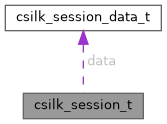
Session structure.
Represents an individual session with a UUID-based ID, an expiry timestamp, a linked list of key-value data items, and a pointer to the next session in the global store (singly-linked list).
| Data Fields | ||
|---|---|---|
| csilk_session_data_t * | data | |
| time_t | expires_at | |
| char | id[37] | |
| struct csilk_session_s * | next | |
Macro Definition Documentation
◆ SESSION_COOKIE
| #define SESSION_COOKIE "csilk_session" |
Session cookie name.
◆ SESSION_TTL
| #define SESSION_TTL 3600 |
Default session TTL (seconds).
Function Documentation
◆ add_session_locked()
|
static |
Add a session to the store (acquires and releases the mutex).
Prepends the session to the global singly-linked list of active sessions.
- Parameters
-
session The session to add. Must not be NULL.
◆ cleanup_expired()
|
static |
Remove expired sessions from the global store.
Iterates over the session list and removes (frees) every session whose expires_at timestamp is <= the current time. Also frees all key-value data items belonging to each expired session.
- Note
- Acquires and releases session_mutex during the sweep.
◆ csilk_session_destroy()
| void csilk_session_destroy | ( | csilk_ctx_t * | c | ) |
Destroy the current session.
Destroy the session and clear the session cookie.
Removes the session from the global store, frees all its key-value data items and the session struct itself, clears the "_session" context entry, and sets an empty session cookie with a negative max-age to instruct the client to delete it.
- Parameters
-
c The request context.
◆ csilk_session_get()
| void * csilk_session_get | ( | csilk_ctx_t * | c, |
| const char * | key | ||
| ) |
Retrieve a value from the session.
Searches the current session's data list for the given key and returns its associated value.
- Parameters
-
c The request context (used to look up the session). key Null-terminated key string. Must not be NULL.
- Returns
- The value pointer previously stored with csilk_session_set(), or NULL if the key is not found or no session is active.
◆ csilk_session_init()
| void csilk_session_init | ( | void | ) |
Initialize the session system.
Initialise the session subsystem (call once at startup).
Performs an immediate cleanup of any expired sessions from the store. This should be called once during server startup.
◆ csilk_session_set()
| void csilk_session_set | ( | csilk_ctx_t * | c, |
| const char * | key, | ||
| void * | value | ||
| ) |
Store a value in the session.
If the key already exists in the current session, its value is replaced. Otherwise, a new key-value pair is prepended to the session's data list.
- Parameters
-
c The request context (used to look up the session via csilk_get(c, "_session")). key Null-terminated key string. Must not be NULL. value Opaque pointer to the value to store. May be NULL.
- Note
- The key is duplicated via strdup(). The value pointer is stored as-is — the caller is responsible for managing its lifetime.
- Warning
- This function does NOT acquire the session mutex. It operates on the session pointer stored in the per-request context, which is already exclusively owned by the current request handler.
◆ csilk_session_start()
| void csilk_session_start | ( | csilk_ctx_t * | c | ) |
Start or resume a session for the current request.
Looks for an existing session cookie named "csilk_session". If a valid session is found, its expiry is extended by SESSION_TTL seconds. If not, a new session is created with a fresh UUID, stored in the global list, and a session cookie is set on the response. The session pointer is stored in the context under the key "_session".
- Parameters
-
c The request context.
- Note
- Must be called after csilk_request_id_middleware (or equivalent) so that _csilk_generate_uuid is available.
- Warning
- The session's data items are NOT automatically serialized to persistent storage. All sessions are in-memory and are lost on process restart.
◆ find_session()
|
static |
Find a session by ID in the global store.
Performs a linear search of the singly-linked session list.
- Parameters
-
id The session ID string to search for.
- Returns
- Pointer to the csilk_session_t if found, NULL otherwise.
- Note
- This function does NOT acquire the mutex. The caller must hold session_mutex when calling this function.
◆ find_session_locked()
|
static |
Find a session by ID (acquires and releases the mutex).
Convenience wrapper around find_session() that handles locking for single-lookup callers.
- Parameters
-
id The session ID string to search for.
- Returns
- Pointer to the csilk_session_t if found, NULL otherwise.
◆ generate_session_id()
|
static |
Generate a cryptographically random session ID.
Delegates to _csilk_generate_uuid() to produce a UUID v4 string and writes it into the provided 37-character buffer.
- Parameters
-
c The request context. id Output buffer of at least 37 bytes to receive the null-terminated UUID string.
◆ init_session_mutex()
|
static |
Initialize the session store mutex (called once via uv_once).
◆ remove_session_locked()
|
static |
Remove a session from the store (acquires and releases the mutex).
Unlinks the session from the global singly-linked list of active sessions. Does NOT free the session or its data — the caller must do that after removal.
- Parameters
-
session The session to remove. Must be a valid pointer currently in the store.
◆ session_lock()
|
static |
Lock the session store mutex.
Ensures the mutex is initialized (via uv_once) before acquiring the lock. Blocks until the lock is held.
◆ session_unlock()
|
static |
Unlock the session store mutex.
Releases the lock previously acquired by session_lock().
Variable Documentation
◆ session_mutex
|
static |
Session store mutex — guards session_store and all linked-list operations against concurrent access.
◆ session_mutex_once
|
static |
One-time initialization guard for session_mutex.
Ensures uv_mutex_init is called exactly once across all threads, regardless of which thread triggers the first session operation.
◆ session_store
|
static |
Global session store (singly-linked list of active sessions).
Protected by a libuv mutex. All read/write access to this pointer must occur while session_mutex is held. The linked-list design is chosen over a hash table for simplicity; with typical concurrency levels the O(n) traversal is acceptable for <10K active sessions.
