Loading...
Searching...
No Matches
workflow_wal.c File Reference
Binary Write-Ahead Log implementation for AI workflows. More...
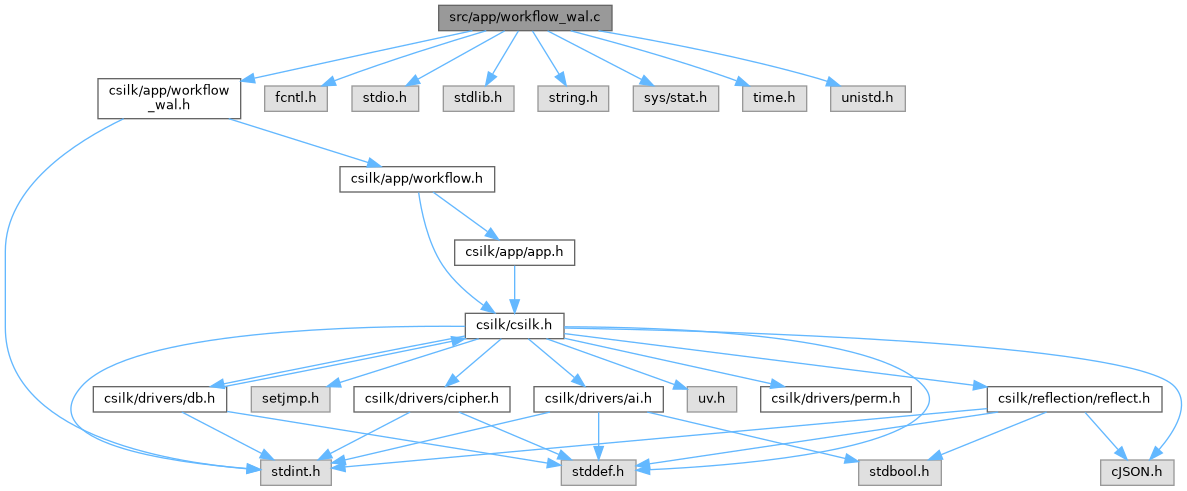
#include "csilk/app/workflow_wal.h"#include <fcntl.h>#include <stdio.h>#include <stdlib.h>#include <string.h>#include <sys/stat.h>#include <time.h>#include <unistd.h>
Include dependency graph for workflow_wal.c:
Functions | |
| int | _wf_wal_append (const char *wal_path, csilk_wf_event_type_t type, const void *payload, size_t len) |
| Append an event record to the workflow Write-Ahead Log. | |
Detailed Description
Binary Write-Ahead Log implementation for AI workflows.
Architecture: Crash-safe durability for workflow execution state. Events (node start, node finish, workflow end) are written as fixed-size headers + variable-length payloads to a binary WAL file. Each record is fsynced before returning to guarantee durability.
The WAL is replayed during csilk_wf_resume() to reconstruct the workflow's execution state after a crash or restart.
Wire format: [magic:4 bytes][type:1 byte][timestamp:4 bytes][payload_len:4 bytes] [payload:payload_len bytes]
- Copyright
- MIT License
Function Documentation
◆ _wf_wal_append()
| int _wf_wal_append | ( | const char * | wal_path, |
| csilk_wf_event_type_t | type, | ||
| const void * | payload, | ||
| size_t | len | ||
| ) |
Append an event record to the workflow Write-Ahead Log.
Append a WAL record to the log file.
Algorithm:
- Open (or create) the WAL file in O_WRONLY | O_APPEND mode.
- Write a fixed-size csilk_wf_wal_header_t (magic, type, timestamp, payload_len).
- If payload_len > 0 and payload is non-NULL, write the payload bytes immediately after the header.
- fdatasync() the file to flush the data to disk before closing.
- Parameters
-
wal_path Absolute path to the WAL file. type Event type (e.g., WF_EV_START, WF_EV_NODE_FINISH). payload Opaque payload data to persist (may be NULL if len is 0). len Number of payload bytes.
- Returns
- 0 on success, -1 if wal_path is NULL or any write fails.
- Note
- Not thread-safe for concurrent writes to the same file — callers should serialize access at the workflow context level.
